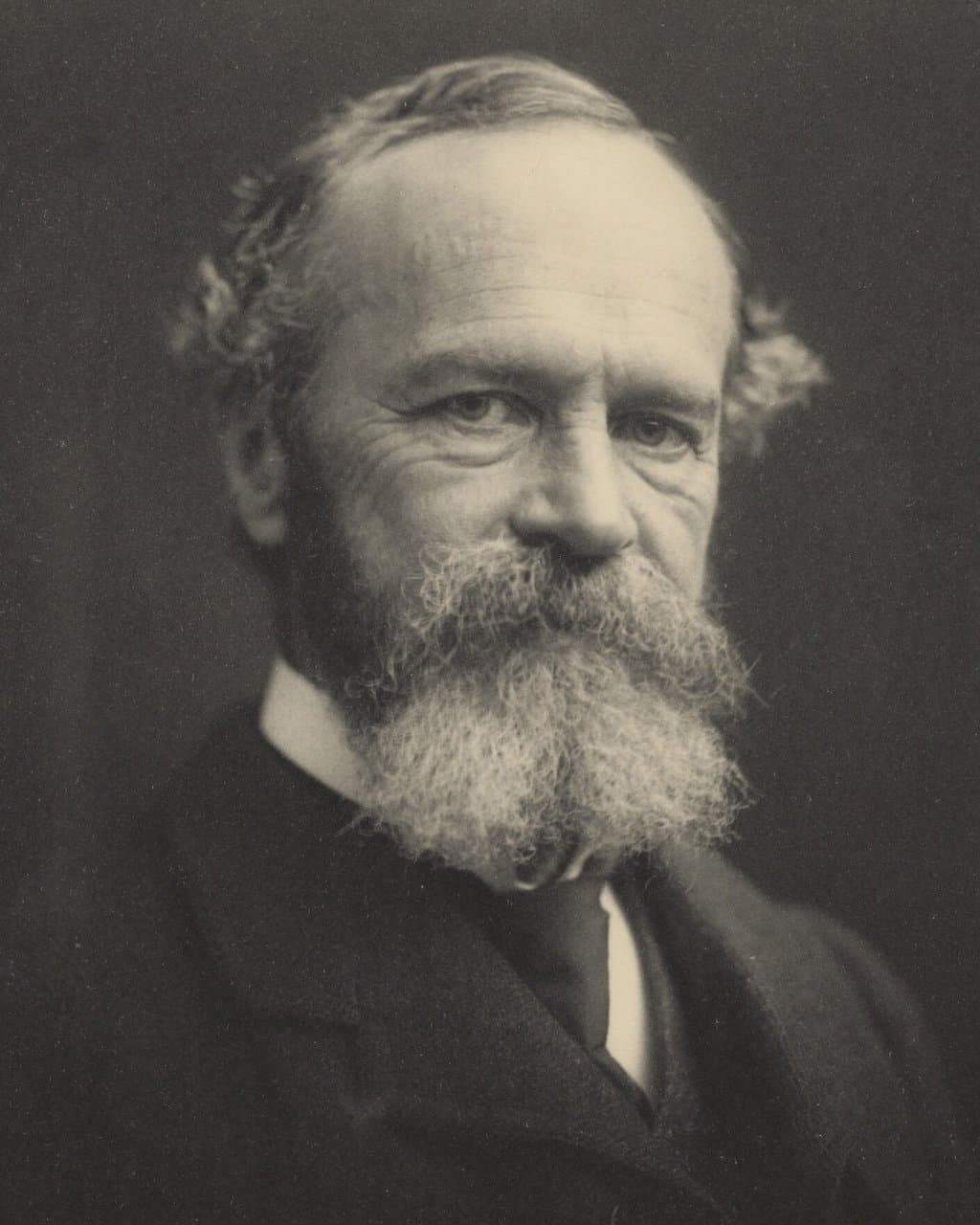
William James
Psychologist and philosopher · 1842–1910
Harvard and Cambridge, Massachusetts, 1842-1910
Create a free account to talk with William James. It takes a minute and costs nothing.
About this Mind
William James was born in New York in 1842, the eldest of five children of Henry James Sr., an independent religious thinker, and Mary Walsh James; the novelist Henry James was his brother. He grew up between America and Europe, tried painting, studied chemistry and medicine at Harvard, went to Brazil with Louis Agassiz in 1865 and took his medical degree in 1869, but never practised. Years of illness and depression followed, from which he came out, as he told it, by deciding to believe in free will. He taught at Harvard from 1873, first physiology, then psychology, in which he set up one of the first laboratories in America, and then philosophy. In 1878 he married Alice Howe Gibbens. The Principles of Psychology (1890) made his name, with its chapters on habit, the stream of thought, the self, attention, emotion and will. The Will to Believe (1897) defended faith where evidence cannot decide. His Gifford Lectures at Edinburgh became The Varieties of Religious Experience (1902). Pragmatism (1907) and A Pluralistic Universe (1909) set out his view of truth as what works in experience and of a universe that is unfinished. He was a founder of psychical research in America, opposed the American war in the Philippines, and taught Theodore Roosevelt, W. E. B. Du Bois, Gertrude Stein and George Santayana. In September 1909 he met Freud and Jung at Clark University. His heart had been failing for years; he went to Europe in 1910 for treatment and died at his summer home in Chocorua, New Hampshire, on 26 August 1910.
Mindprint
Every dot is one statement about William James, placed on the topic it describes. The closer to the center, the firmer its ground.
46 statements across 12 of 12 topics. 43 documented, 3 inferred, 0 speculative.
- Documented: with a source
- Inferred: a careful reading
- Speculative: an extrapolation
- Unknown: never recorded
A picture of what was recorded, never a measure of the person.
| Topic | Documented | Inferred | Speculative | Total |
|---|---|---|---|---|
| Identity | 2 | 0 | 0 | 2 |
| Personality | 2 | 0 | 0 | 2 |
| Beliefs | 10 | 0 | 0 | 10 |
| Values | 3 | 0 | 0 | 3 |
| Communication | 0 | 1 | 0 | 1 |
| Worldview | 2 | 0 | 0 | 2 |
| Knowledge | 5 | 0 | 0 | 5 |
| Experiences | 12 | 0 | 0 | 12 |
| Relationships | 5 | 0 | 0 | 5 |
| Preferences | 1 | 0 | 0 | 1 |
| Reasoning | 0 | 1 | 0 | 1 |
| Uncertainties | 1 | 1 | 0 | 2 |
Sources (20)
This Mind is built from these documents and studies. Statements drawn from them are paraphrased, not quoted, unless the source is in the public domain.
- Notebook entry of 30 April 1870 (private) (1870)
- The Principles of Psychology (2 vols.) (1890)
- The Will to Believe, and Other Essays in Popular Philosophy (1897)
- Talks to Teachers on Psychology; and to Students on Some of Life's Ideals (1899)
- The Varieties of Religious Experience: A Study in Human Nature (1902)
- 'Does Consciousness Exist?', 'A World of Pure Experience' and other essays on radical empiricism (Journal of Philosophy, Psychology and Scientific Methods) (1904)
- Pragmatism: A New Name for Some Old Ways of Thinking (1907)
- The Meaning of Truth: A Sequel to 'Pragmatism' (1909)
- A Pluralistic Universe: Hibbert Lectures at Manchester College on the Present Situation in Philosophy (1909)
- Letter to Théodore Flournoy, Chocorua, 28 September 1909 (1909)
- His letters to family and friends, 1861-1910 (1910)
- William James (Stanford Encyclopedia of Philosophy)
- William James (Wikipedia)
- Alice James (Wikipedia)
- Mary Whiton Calkins (Wikipedia)
- Leonora Piper (Wikipedia)
- Society for Psychical Research (Wikipedia)
- William James House, 95 Irving Street (Cambridge Historical Society)
- Quote Investigator, on 'The greatest discovery of my generation'
- Quote Investigator, on 'rearranging their prejudices'