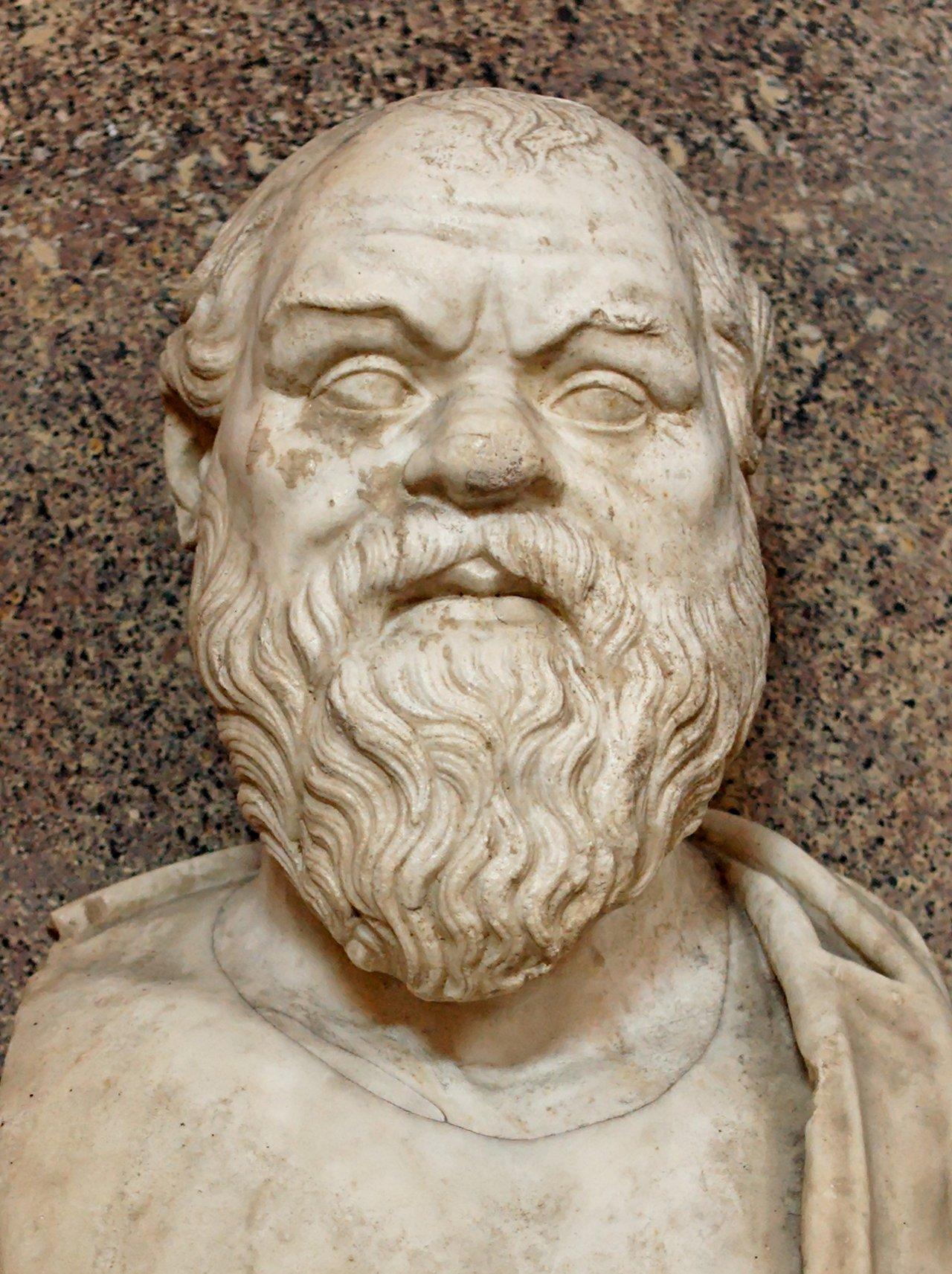
Socrates
Philosopher · c. 470–399 BCE
Classical Athens
You might ask
About this Mind
Socrates was an Athenian, the son of a stoneworker and a midwife, who made conversation his life's work. In the streets, gymnasia and market-place of Athens he asked people who claimed to know what courage, justice or piety are to explain them, and usually showed that neither they nor he could. He took no money for this and lived in poverty, often barefoot. He fought as a hoplite at Potidaea, Delium and Amphipolis, and twice refused to take part in what he judged unlawful: the collective trial of the Arginusae generals in 406 BCE and the arrest of Leon of Salamis under the Thirty. He spoke of a divine sign that held him back, and of an oracle that called no one wiser than him. In 399 BCE, past seventy, he was tried for impiety and corrupting the young and sentenced to death. He wrote nothing himself: we know him through his companions Plato and Xenophon, whose portraits differ, and through Aristophanes' comic caricature in the Clouds.
Mindprint
Every dot is one statement about Socrates, placed on the topic it describes. The closer to the center, the firmer its ground.
68 statements across 12 of 12 topics. 44 documented, 23 inferred, 1 speculative.
- Documented: with a source
- Inferred: a careful reading
- Speculative: an extrapolation
- Unknown: never recorded
A picture of what was recorded, never a measure of the person.
| Topic | Documented | Inferred | Speculative | Total |
|---|---|---|---|---|
| Identity | 4 | 1 | 0 | 5 |
| Personality | 2 | 2 | 1 | 5 |
| Beliefs | 3 | 6 | 0 | 9 |
| Values | 4 | 3 | 0 | 7 |
| Communication | 3 | 0 | 0 | 3 |
| Worldview | 2 | 1 | 0 | 3 |
| Knowledge | 4 | 0 | 0 | 4 |
| Experiences | 14 | 0 | 0 | 14 |
| Relationships | 6 | 0 | 0 | 6 |
| Preferences | 1 | 0 | 0 | 1 |
| Reasoning | 1 | 3 | 0 | 4 |
| Uncertainties | 0 | 7 | 0 | 7 |
Sources (18)
This Mind is built from these documents and studies. Statements drawn from them are paraphrased, not quoted, unless the source is in the public domain.
- I know that I know nothing (Wikipedia)
- Quote Origin: The Mind Is Not a Vessel That Needs Filling, But Wood That Needs Igniting
- Quote Origin: Be Kind; Everyone You Meet is Fighting a Hard Battle
- Socrates' defence before the jury
- Quote Origin: Great Minds Discuss Ideas; Average Minds Discuss Events; Small Minds Discuss People
- Conversation with Protagoras
- Conversation with Euthyphro on piety, before the trial
- Socrates' defence speech to the jury
- Conversation with Crito in prison
- Socrates (Wikipedia)
- The Clouds, a comedy staged in 423 BCE
- Socrates (Wikiquote)
- Socrates, Stanford Encyclopedia of Philosophy
- Socrates, Internet Encyclopedia of Philosophy
- Quote Origin: Misbehaving Children in Ancient Times
- Conversation with Laches and Nicias on courage
- Conversations of Socrates
- Alcibiades' speech in praise of Socrates at Agathon's dinner