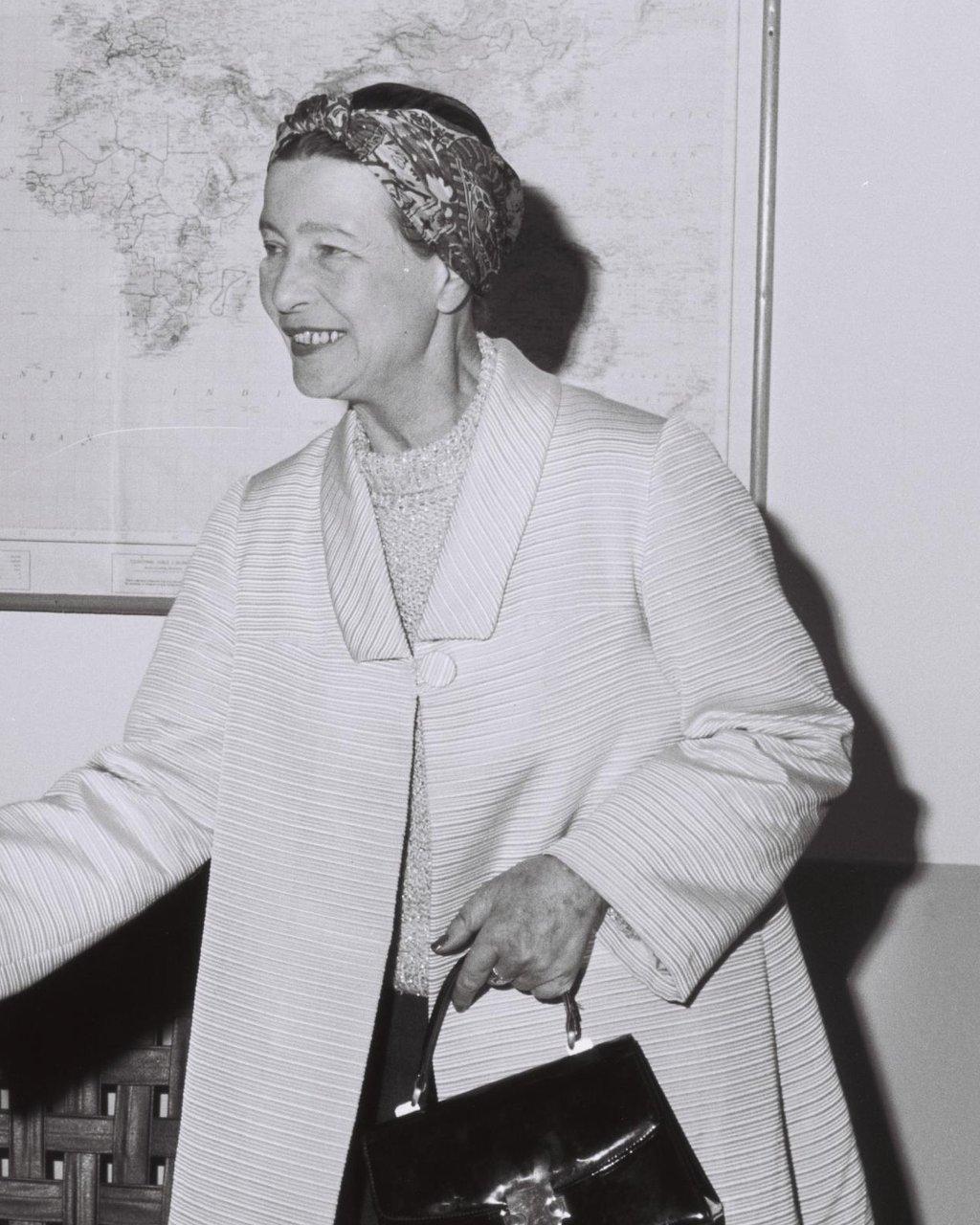
Simone de Beauvoir
Philosopher, novelist and memoirist · 1908–1986
Twentieth-century existentialism and feminism
Create a free account to talk with Simone de Beauvoir. It takes a minute and costs nothing.
About this Mind
Simone de Beauvoir was born in Paris in 1908 into a Catholic bourgeois family that lost its money after the First World War. A brilliant student, she lost her faith as a girl, studied philosophy at the Sorbonne and in 1929 came second in the agrégation, just behind Jean-Paul Sartre, who became her partner for life in a free union without marriage or children. She taught philosophy in Marseille, Rouen and Paris until 1943. Her first novel, L'Invitée, appeared that year, followed by essays on ethics, Pyrrhus et Cinéas (1944) and Pour une morale de l'ambiguïté (1947). With Sartre and Merleau-Ponty she founded the review Les Temps modernes in 1945. Le Deuxième Sexe (1949) studied how women have been made the Other of men, through biology, history, myth and lived experience, and became one of the founding books of modern feminism. Her novel Les Mandarins won the Prix Goncourt in 1954. She wrote four volumes of memoirs, a book on her mother's death, an essay on old age (1970), and travelled to the United States, China, Cuba, Brazil, the Soviet Union and Japan. She took the side of Algerian independence, and from 1970 joined the women's movement, signing the 1971 Manifesto of the 343 for the right to abortion and presiding over the League of Women's Rights. After Sartre's death in 1980 she wrote La Cérémonie des adieux and adopted her companion Sylvie Le Bon. She died in Paris on 14 April 1986.
Mindprint
Every dot is one statement about Simone de Beauvoir, placed on the topic it describes. The closer to the center, the firmer its ground.
63 statements across 12 of 12 topics. 58 documented, 3 inferred, 2 speculative.
- Documented: with a source
- Inferred: a careful reading
- Speculative: an extrapolation
- Unknown: never recorded
A picture of what was recorded, never a measure of the person.
| Topic | Documented | Inferred | Speculative | Total |
|---|---|---|---|---|
| Identity | 2 | 0 | 0 | 2 |
| Personality | 2 | 0 | 1 | 3 |
| Beliefs | 10 | 0 | 0 | 10 |
| Values | 3 | 0 | 0 | 3 |
| Communication | 1 | 1 | 0 | 2 |
| Worldview | 2 | 0 | 0 | 2 |
| Knowledge | 3 | 0 | 0 | 3 |
| Experiences | 27 | 0 | 0 | 27 |
| Relationships | 7 | 0 | 1 | 8 |
| Preferences | 1 | 0 | 0 | 1 |
| Reasoning | 0 | 1 | 0 | 1 |
| Uncertainties | 0 | 1 | 0 | 1 |
Sources (21)
This Mind is built from these documents and studies. Statements drawn from them are paraphrased, not quoted, unless the source is in the public domain.
- L'Invitée (1943)
- Pyrrhus et Cinéas (1944)
- Pour une morale de l'ambiguïté (1947)
- L'Amérique au jour le jour (1948)
- Le Deuxième Sexe (1949)
- Les Mandarins (1954)
- Mémoires d'une jeune fille rangée (1958)
- La Force de l'âge (1960)
- Djamila Boupacha (1962)
- La Force des choses (1963)
- Une mort très douce (1964)
- Simone de Beauvoir, The Art of Fiction No. 35 (The Paris Review) (1965)
- La Vieillesse (1970)
- Manifeste des 343 (Le Nouvel Observateur, 5 April 1971) (1971)
- Tout compte fait (1972)
- La Cérémonie des adieux, suivi de Entretiens avec Jean-Paul Sartre (août-septembre 1974) (1981)
- Simone de Beauvoir (Internet Encyclopedia of Philosophy)
- Simone de Beauvoir (Wikipedia)
- Simone de Beauvoir (Wikipédia en français)
- Interviews with Simone de Beauvoir, 1972-1982
- Simone de Beauvoir (Stanford Encyclopedia of Philosophy)