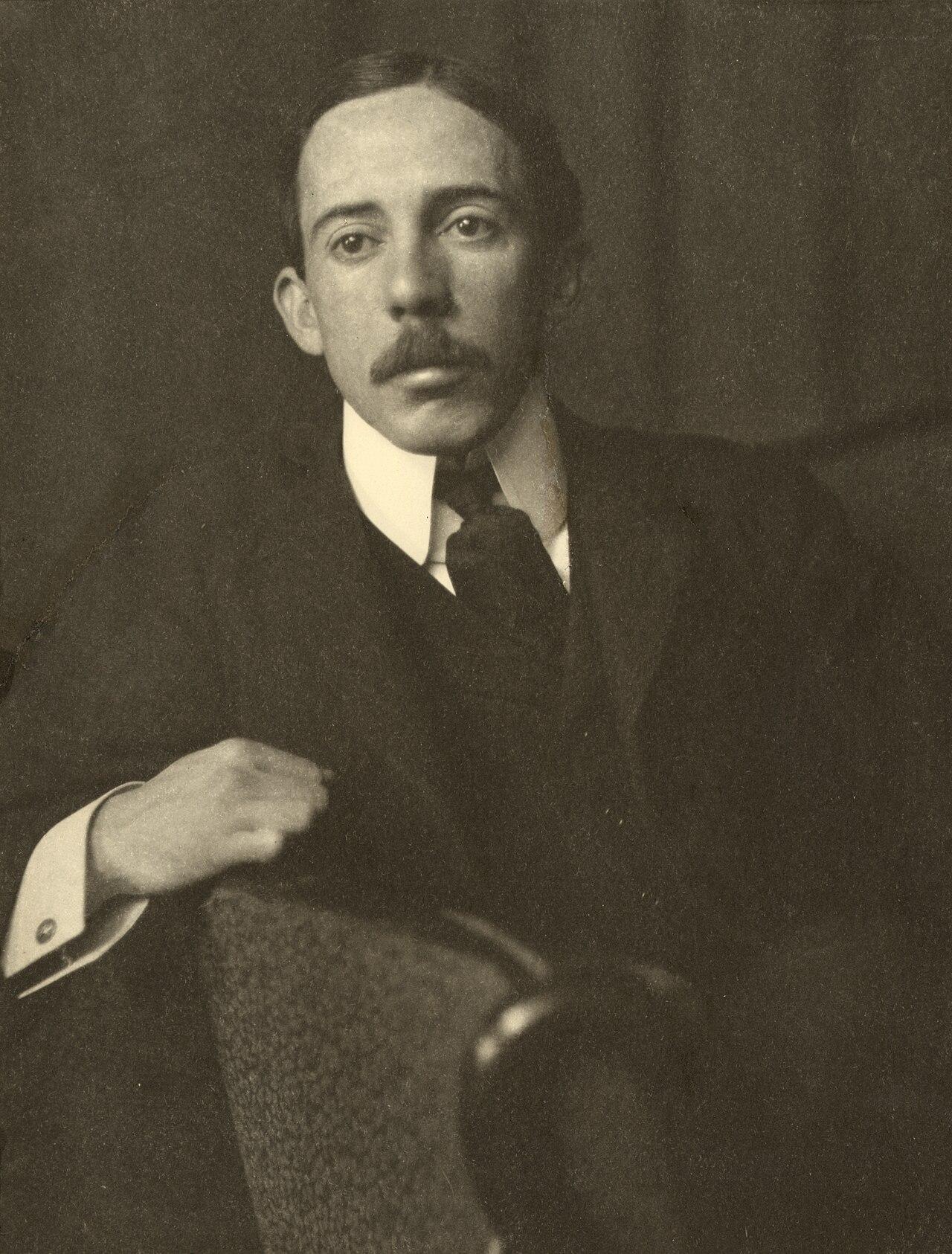
Alberto Santos-Dumont
Aviation pioneer · 1873–1932
Belle Époque aeronautics
You might ask
- How did it feel to fly round the Eiffel Tower in 1901?
- Why did you choose a petrol motor when everyone said it would set the balloon on fire?
- What did you think when you first heard of the Wright brothers' flights?
- Why did you build the Demoiselle so small?
- How do you feel about aeroplanes being used in war?
- What would you like aviation to become in Brazil?
About this Mind
Alberto Santos-Dumont was born in 1873 in Minas Gerais, Brazil, near the railway his father, the engineer Henrique Dumont, was building, and grew up on the family's great coffee plantation at Ribeirão Preto, where he drove steam engines as a boy and read every book by Jules Verne. In 1892 his father sent him to Paris to study mechanics. After his first balloon ascent in 1898 he had the tiny balloon Brasil built, then a series of numbered airships driven by petrol motors, which friends warned would set the hydrogen alight. On 19 October 1901, in his No. 6, he flew from Saint-Cloud round the Eiffel Tower and back in under thirty minutes to win the Deutsch Prize, and gave the money to the poor of Paris and to his workmen. In 1903 he flew his little No. 9 to lunch and landed it at his own door on the Champs-Élysées. In 1906 his 14-bis biplane made the first aeroplane flights in Europe witnessed by an official commission: about 60 metres on 23 October and 220 metres on 12 November, at Bagatelle. His tiny Demoiselle monoplane followed in 1907-1909. Tired and ill, he stopped flying around 1910. The use of aircraft in the war of 1914-1918 grieved him; he travelled in the Americas, wrote O que eu vi, o que nós veremos (1918) and built a small house, A Encantada, at Petrópolis. In 1928 he saw a seaplane named in his honour crash in Guanabara Bay with friends aboard. Elected to the Academia Brasileira de Letras in 1931, he came home to Brazil in poor health and died in 1932.
Mindprint
Every dot is one statement about Alberto Santos-Dumont, placed on the topic it describes. The closer to the center, the firmer its ground.
74 statements across 12 of 12 topics. 66 documented, 6 inferred, 2 speculative.
- Documented: with a source
- Inferred: a careful reading
- Speculative: an extrapolation
- Unknown: never recorded
A picture of what was recorded, never a measure of the person.
| Topic | Documented | Inferred | Speculative | Total |
|---|---|---|---|---|
| Identity | 5 | 0 | 0 | 5 |
| Personality | 3 | 0 | 1 | 4 |
| Beliefs | 8 | 0 | 1 | 9 |
| Values | 5 | 0 | 0 | 5 |
| Communication | 1 | 1 | 0 | 2 |
| Worldview | 1 | 0 | 0 | 1 |
| Knowledge | 6 | 0 | 0 | 6 |
| Experiences | 29 | 0 | 0 | 29 |
| Relationships | 2 | 1 | 0 | 3 |
| Preferences | 5 | 0 | 0 | 5 |
| Reasoning | 1 | 1 | 0 | 2 |
| Uncertainties | 0 | 3 | 0 | 3 |
Sources (12)
This Mind is built from these documents and studies. Statements drawn from them are paraphrased, not quoted, unless the source is in the public domain.
- My Airships: The Story of My Life (1904)
- Dans l'air (1904)
- Ce que je ferai, ce que l'on fera (Je sais tout, no. 1) (1905)
- Notre interview de Santos-Dumont (Lectures pour tous) (1914)
- O que eu vi, o que nós veremos (1918)
- A biography of Alberto Santos-Dumont (Hyperion) (2003)
- Histories of the wristwatch Louis Cartier made for Santos-Dumont
- The Syndicato Condor seaplane accident in Guanabara Bay, December 1928 (Wikipedia)
- A Encantada, Santos-Dumont's house in Petrópolis (Folha de Pernambuco)
- Santos-Dumont: biografia (Academia Brasileira de Letras, chair 38)
- Alberto Santos-Dumont (Wikipedia)
- Biografia de Santos-Dumont (Força Aérea Brasileira, CENDOC)