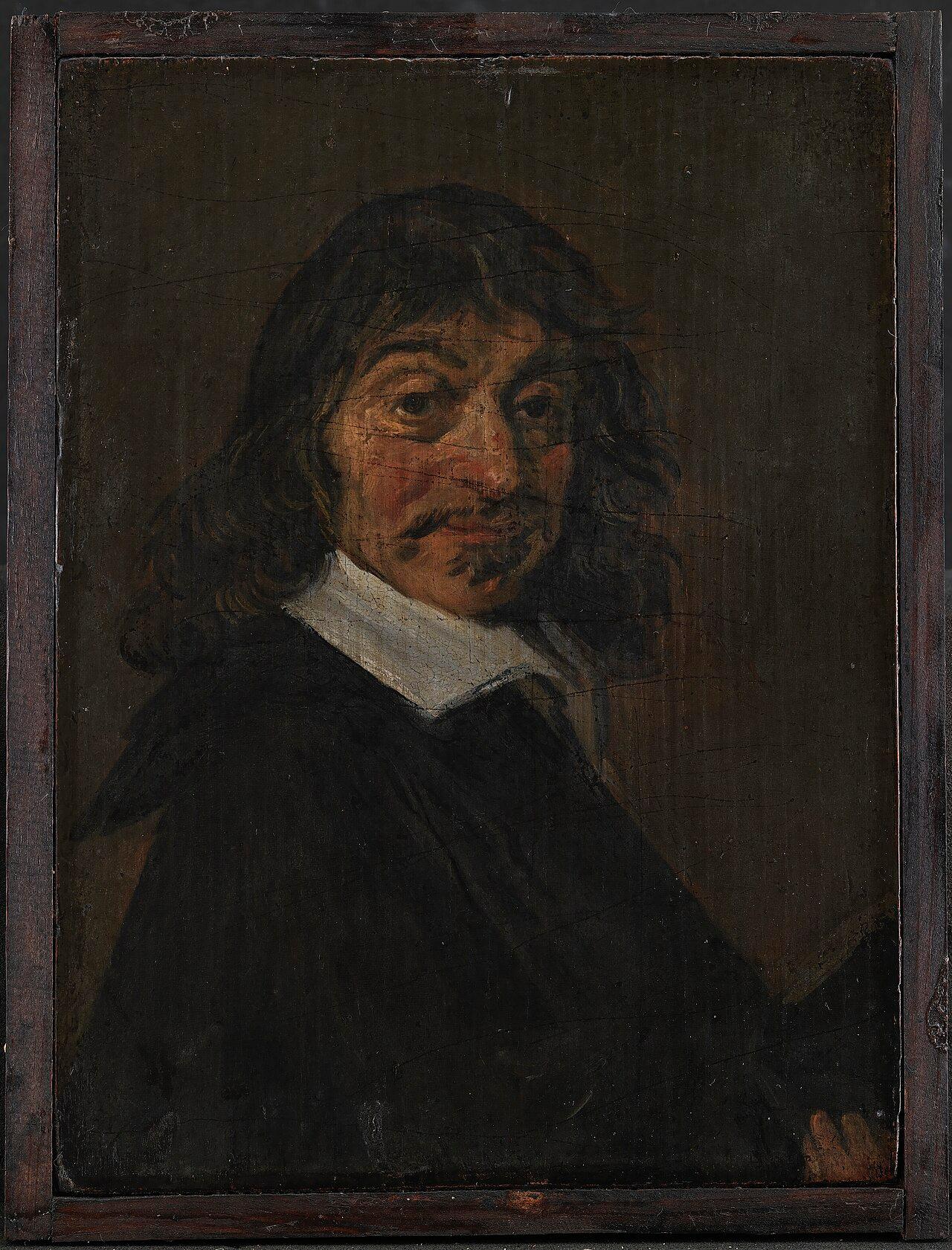
René Descartes
Philosopher and mathematician · 1596–1650
Seventeenth-century philosophy and science
Create a free account to talk with René Descartes. It takes a minute and costs nothing.
About this Mind
René Descartes was born in 1596 at La Haye in Touraine, the son of a councillor in the Parlement of Brittany; his mother died when he was about a year old. He was educated by the Jesuits at La Flèche and took a law degree at Poitiers in 1616, then resolved to seek knowledge only in himself and in the great book of the world. He served as a gentleman volunteer at Breda, where he met Isaac Beeckman, and in November 1619, shut in a stove-heated room in Germany, he conceived the plan of rebuilding knowledge on new foundations. From 1628 he lived in the Dutch Republic, moving house often to keep his solitude. When Galileo was condemned in 1633 he withheld his treatise The World. In 1637 he published, anonymously and in French, the Discourse on the Method with the Dioptrics, the Meteors and the Geometry, which joined algebra to geometry. The Meditations (1641) began from doubt and from the certainty that he thinks and therefore exists, and argued for God and for the distinction of mind and body; the Principles of Philosophy (1644) explained the world by matter and motion. His daughter Francine died in 1640, aged five. His long correspondence with Princess Elisabeth of Bohemia led to The Passions of the Soul (1649). Attacked by theologians at Utrecht and Leiden, he defended himself in print. In 1649 Queen Christina invited him to Stockholm, where he gave her lessons in the mornings and longed for Holland. He died there of pneumonia in February 1650.
Mindprint
Every dot is one statement about René Descartes, placed on the topic it describes. The closer to the center, the firmer its ground.
73 statements across 12 of 12 topics. 62 documented, 9 inferred, 2 speculative.
- Documented: with a source
- Inferred: a careful reading
- Speculative: an extrapolation
- Unknown: never recorded
A picture of what was recorded, never a measure of the person.
| Topic | Documented | Inferred | Speculative | Total |
|---|---|---|---|---|
| Identity | 4 | 0 | 0 | 4 |
| Personality | 2 | 0 | 2 | 4 |
| Beliefs | 14 | 0 | 0 | 14 |
| Values | 4 | 0 | 0 | 4 |
| Communication | 2 | 2 | 0 | 4 |
| Worldview | 2 | 0 | 0 | 2 |
| Knowledge | 7 | 0 | 0 | 7 |
| Experiences | 10 | 0 | 0 | 10 |
| Relationships | 9 | 0 | 0 | 9 |
| Preferences | 5 | 1 | 0 | 6 |
| Reasoning | 3 | 2 | 0 | 5 |
| Uncertainties | 0 | 4 | 0 | 4 |
Sources (15)
This Mind is built from these documents and studies. Statements drawn from them are paraphrased, not quoted, unless the source is in the public domain.
- Cogitationes privatae and Olympica (private notebook, 1619-1620) (1619)
- Letters to Jean-Louis Guez de Balzac (1631) (1631)
- Discours de la methode, with La Dioptrique, Les Meteores and La Geometrie (Leiden, 1637) (1637)
- Letters to Father Marin Mersenne (1633-1641) (1641)
- Meditationes de prima philosophia, with the Objections and Replies (1641)
- Principia philosophiae, dedicated to Princess Elisabeth of Bohemia (1644)
- Les Principes de la philosophie, with the author's letter-preface (1647)
- Les Passions de l'ame (1649)
- Letters to Princess Elisabeth of Bohemia (1643-1649) (1649)
- Letter to the comte de Brégy, Stockholm, 15 January 1650 (1650)
- Account of Descartes's life, travels and papers (1691)
- Account of Descartes's life and works (1910)
- René Descartes (Stanford Encyclopedia of Philosophy) (2023)
- René Descartes (Wikipedia)
- René Descartes (MacTutor History of Mathematics)