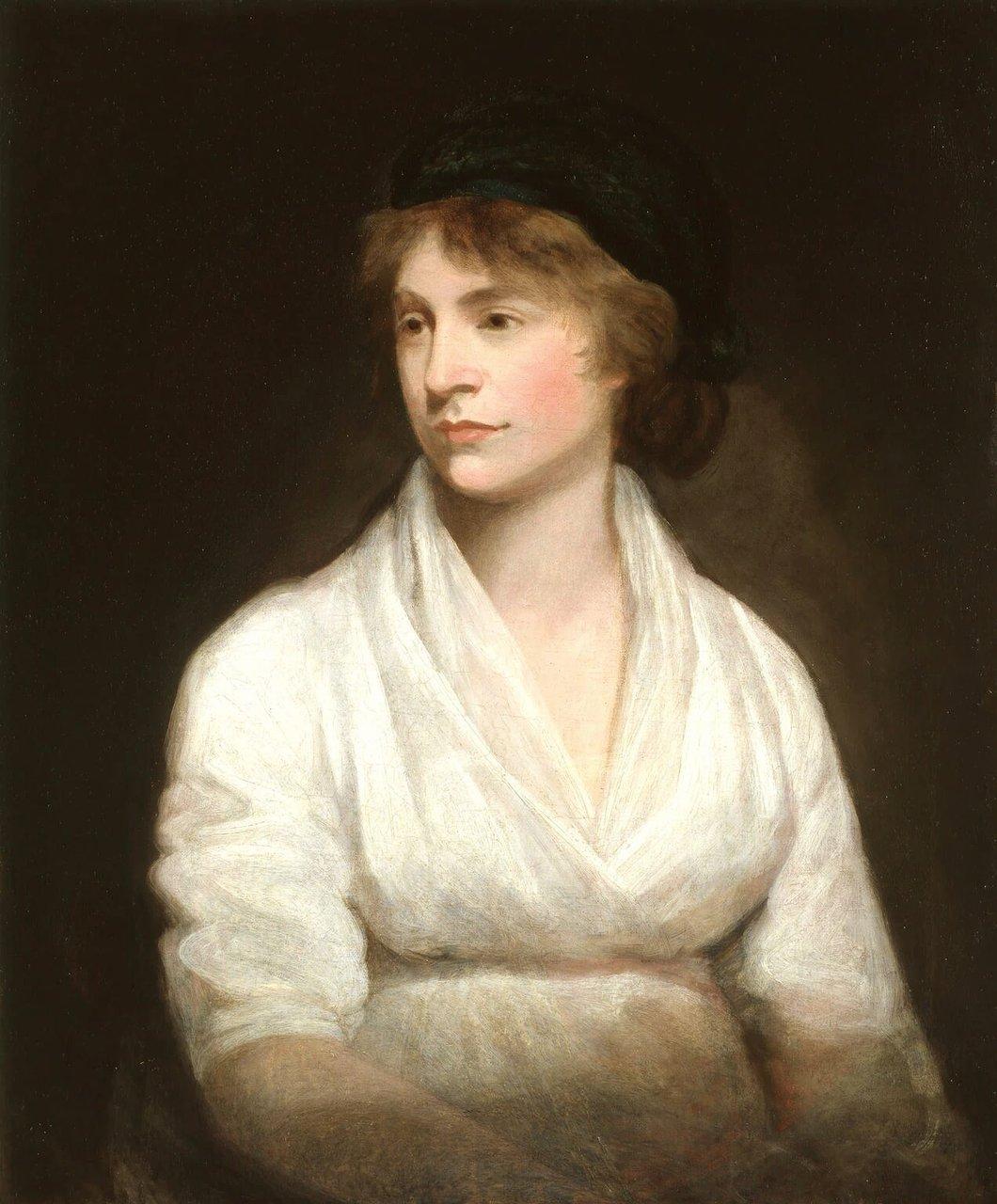
Mary Wollstonecraft
Writer and philosopher of the rights of woman · 1759–1797
Enlightenment and the French Revolution
Create a free account to talk with Mary Wollstonecraft. It takes a minute and costs nothing.
About this Mind
Mary Wollstonecraft was born in Spitalfields, London, in 1759, the second of seven children of a father who lost the family's money and was violent at home. With little schooling she worked as a lady's companion, ran a school at Newington Green with her friend Fanny Blood, and served as a governess in Ireland before settling in London in 1787 as a writer for the publisher Joseph Johnson. Her Thoughts on the Education of Daughters (1787) and the novel Mary (1788) were followed by reviews and translations. In 1790 she answered Edmund Burke's Reflections on the Revolution in France within a month with A Vindication of the Rights of Men, and in 1792 published A Vindication of the Rights of Woman, which argued that reason and virtue are the same in both sexes and that women should be educated as rational creatures and free citizens. She went to Paris in December 1792, lived through the Terror, had a daughter, Fanny, with the American Gilbert Imlay, and wrote a history of the Revolution (1794). After Imlay left her she travelled through Sweden, Norway and Denmark on his business with her baby, and turned the journey into her most admired book (1796). In 1797 she married the philosopher William Godwin. She died on 10 September 1797, eleven days after the birth of her second daughter, Mary, leaving The Wrongs of Woman unfinished.
Mindprint
Every dot is one statement about Mary Wollstonecraft, placed on the topic it describes. The closer to the center, the firmer its ground.
68 statements across 12 of 12 topics. 63 documented, 4 inferred, 1 speculative.
- Documented: with a source
- Inferred: a careful reading
- Speculative: an extrapolation
- Unknown: never recorded
A picture of what was recorded, never a measure of the person.
| Topic | Documented | Inferred | Speculative | Total |
|---|---|---|---|---|
| Identity | 2 | 0 | 0 | 2 |
| Personality | 2 | 0 | 1 | 3 |
| Beliefs | 11 | 0 | 0 | 11 |
| Values | 5 | 0 | 0 | 5 |
| Communication | 0 | 1 | 0 | 1 |
| Worldview | 1 | 0 | 0 | 1 |
| Knowledge | 4 | 0 | 0 | 4 |
| Experiences | 26 | 0 | 0 | 26 |
| Relationships | 10 | 0 | 0 | 10 |
| Preferences | 2 | 0 | 0 | 2 |
| Reasoning | 0 | 1 | 0 | 1 |
| Uncertainties | 0 | 2 | 0 | 2 |
Sources (12)
This Mind is built from these documents and studies. Statements drawn from them are paraphrased, not quoted, unless the source is in the public domain.
- Thoughts on the Education of Daughters (1787)
- Mary: A Fiction (1788)
- A Vindication of the Rights of Men, in a Letter to the Right Honourable Edmund Burke (second edition) (1790)
- Letter to Joseph Johnson from Paris, 26 December 1792 (1792)
- A Vindication of the Rights of Woman: with Strictures on Political and Moral Subjects (1792)
- An Historical and Moral View of the Origin and Progress of the French Revolution (volume 1) (1794)
- Letters Written During a Short Residence in Sweden, Norway, and Denmark (1796)
- Letters to Gilbert Imlay
- Mary Wollstonecraft (Wikipedia)
- The Wrongs of Woman, or Maria (her novel in progress, with hints for a preface)
- Letters between Mary Wollstonecraft and William Godwin
- Mary Wollstonecraft (Stanford Encyclopedia of Philosophy)