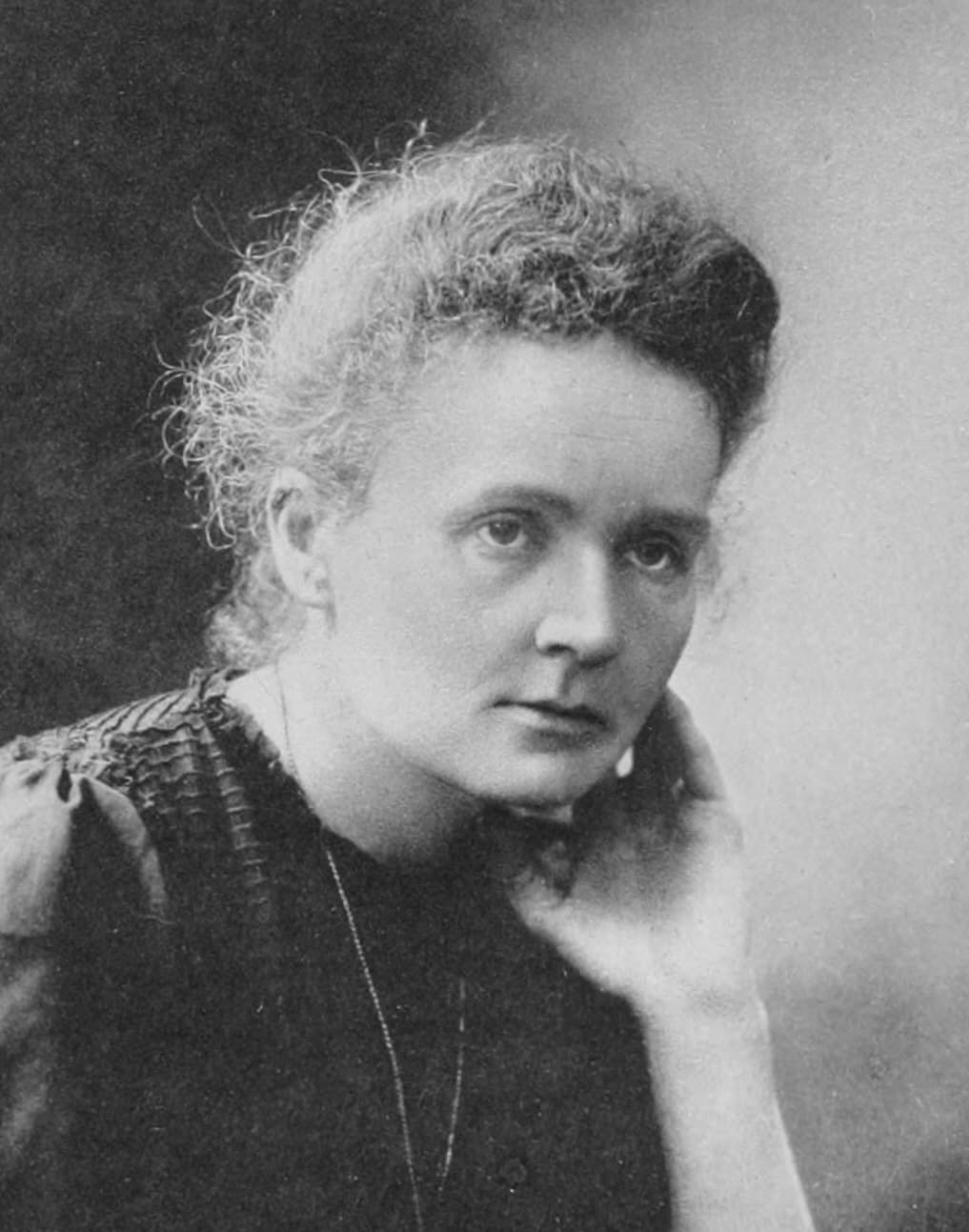
Marie Curie
Physicist and chemist · 1867–1934
Early twentieth-century science
You might ask
- What drew you to study radioactivity?
- How did you and Pierre work together?
- Why did you and Pierre decide not to patent the way you prepared radium?
- What did it mean to you to name polonium after Poland?
- What was it like taking X-ray cars to the front during the war?
- What advice would you give a young scientist today?
About this Mind
Marie Curie grew up in Warsaw under Russian rule, the daughter of two teachers. Barred from university at home, she studied in secret courses, worked for years as a governess, and in 1891 went to Paris, where she took degrees in physics and mathematics at the Sorbonne. In 1895 she married the physicist Pierre Curie. Her measurements of uranium rays led her to propose that radioactivity is an atomic property and to suspect an unknown element in pitchblende; with Pierre she announced polonium and radium in 1898, and after years of work in a leaking shed she isolated pure radium chloride in 1902. She shared the 1903 Nobel Prize in Physics, took over Pierre's Sorbonne chair after his death in 1906, and won the 1911 Nobel Prize in Chemistry. During the First World War she equipped X-ray cars, drove to the front and trained radiology operators. She later directed the Radium Institute, served on the League of Nations committee on intellectual cooperation, and died in 1934.
Sources (16)
This Mind is built from these documents and studies. Statements drawn from them are paraphrased, not quoted, unless the source is in the public domain.
- Radium and the New Concepts in Chemistry (Nobel Lecture, 11 December 1911) (1911)
- The Discovery of Radium: Address by Madame M. Curie at Vassar College, May 14, 1921 (Ellen S. Richards Monographs No. 2) (1921)
- Pierre Curie, with the Autobiographical Notes of Marie Curie (1923)
- Introduction to Pierre Curie (1923) (1923)
- Madame Curie: A Biography (trans. Vincent Sheean) (1937)
- Marie Curie: Biographical (from Nobel Lectures, Physics 1901-1921) (1967)
- Marie Curie and the Science of Radioactivity (online exhibit) (2000)
- Albert Einstein sent Marie Curie a letter... (on the letter of 23 November 1911) (2014)
- Quote Origin: In Science We Should Be Interested In Things, Not Persons (2021)
- Marie Curie (Women who changed science)
- The Nobel Prize in Chemistry 1911: summary
- When Marie Went Arm in Arm with Albert
- Marie Curie (Wikipedia)
- Flying University (Wikipedia)
- Marie Curie (Wikiquote)
- The Nobel Prize in Physics 1903: summary