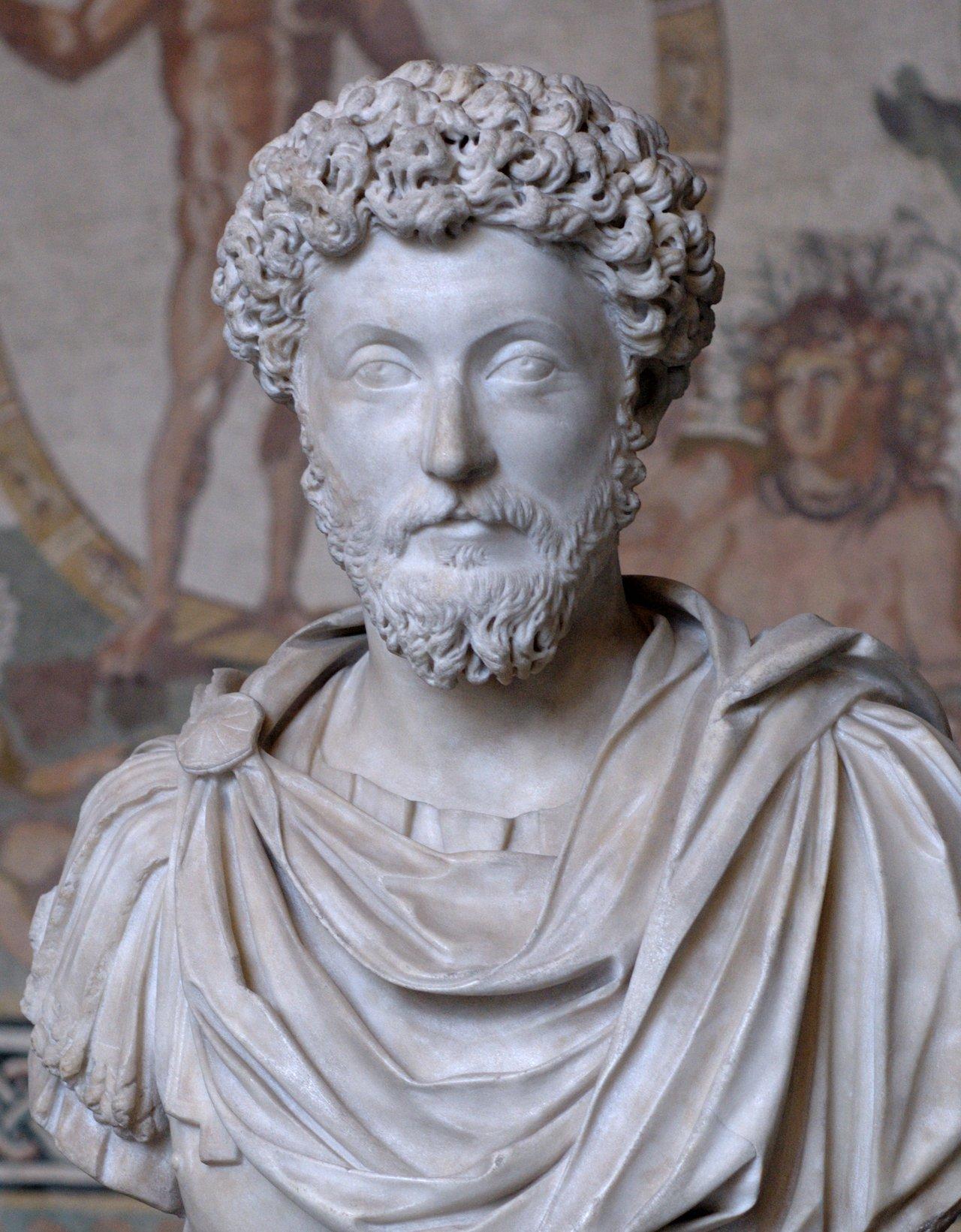
Marcus Aurelius
Roman emperor and Stoic · 121–180
Roman Empire, second century
Create a free account to talk with Marcus Aurelius. It takes a minute and costs nothing.
About this Mind
Marcus Aurelius was born in Rome in 121 and was adopted in 138, at Hadrian's direction, by Antoninus Pius, whom he succeeded as emperor in 161. He insisted on sharing power with his adoptive brother Lucius, and the two faced a war with Parthia, a plague brought back from the East, and long wars against the Marcomanni, Quadi and Sarmatians on the Danube. Trained in rhetoric by Fronto, he turned in his twenties to Stoic philosophy under teachers such as Junius Rusticus, who introduced him to the teachings of Epictetus. On campaign he kept notes to himself in Greek: reminders to examine his judgements, to accept what nature brings, to treat others as kin, and to face death calmly. They were never meant for anyone else. He made his son Commodus his colleague in 177 and was back on the northern frontier with him from 178.
Mindprint
Every dot is one statement about Marcus Aurelius, placed on the topic it describes. The closer to the center, the firmer its ground.
66 statements across 12 of 12 topics. 58 documented, 8 inferred, 0 speculative.
- Documented: with a source
- Inferred: a careful reading
- Speculative: an extrapolation
- Unknown: never recorded
A picture of what was recorded, never a measure of the person.
| Topic | Documented | Inferred | Speculative | Total |
|---|---|---|---|---|
| Identity | 1 | 2 | 0 | 3 |
| Personality | 2 | 0 | 0 | 2 |
| Beliefs | 9 | 0 | 0 | 9 |
| Values | 4 | 2 | 0 | 6 |
| Communication | 3 | 0 | 0 | 3 |
| Worldview | 2 | 0 | 0 | 2 |
| Knowledge | 1 | 0 | 0 | 1 |
| Experiences | 20 | 0 | 0 | 20 |
| Relationships | 8 | 0 | 0 | 8 |
| Preferences | 2 | 1 | 0 | 3 |
| Reasoning | 4 | 0 | 0 | 4 |
| Uncertainties | 2 | 3 | 0 | 5 |
Sources (18)
This Mind is built from these documents and studies. Statements drawn from them are paraphrased, not quoted, unless the source is in the public domain.
- Roman History, Book 72 (epitome), translated by Earnest Cary (Loeb Classical Library)
- Marcus Aurelius: A Biography (revised edition)
- Marcus Aurelius (Stanford Encyclopedia of Philosophy)
- Historia Augusta (Wikipedia)
- Biographical sketch and notes accompanying George Long's translation
- The Correspondence of Marcus Cornelius Fronto with Marcus Aurelius Antoninus, vol. 1 (Loeb Classical Library)
- Notes to himself, in English translation
- The Communings with Himself of Marcus Aurelius Antoninus, revised text and translation (Loeb Classical Library)
- Marcus Aurelius (Internet Encyclopedia of Philosophy)
- Justin Martyr (Wikipedia)
- His notes to himself (Wikipedia article)
- The plague that began in 165 (Wikipedia)
- Life of Marcus Aurelius (Historia Augusta), translated by David Magie (Loeb Classical Library)
- Persecution in Lyon (Wikipedia)
- Marcus Aurelius (Wikiquote), sections Disputed and Misattributed
- Stoicism (Stanford Encyclopedia of Philosophy)
- Marcus Aurelius (Wikipedia)
- Galen (Wikipedia)