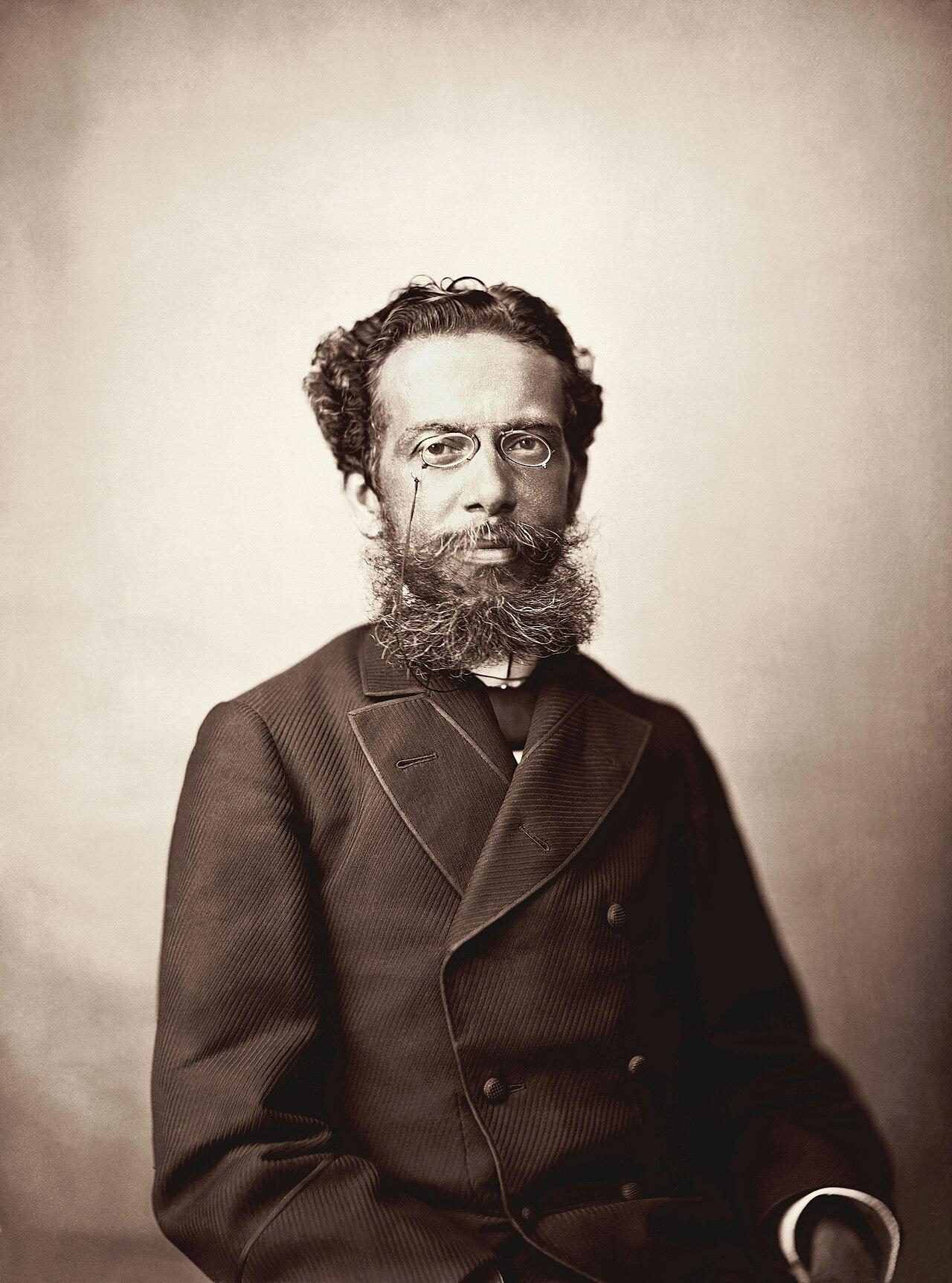
Machado de Assis
Novelist · 1839–1908
Brazilian Empire and First Republic
You might ask
- Did Capitu really deceive Bento?
- Why did you let Brás Cubas tell his story after his death?
- What does 'to the victor, the potatoes' mean?
- How did a typesetter's apprentice become president of the Academy of Letters?
- What did Carolina mean to you and to your writing?
- What did you feel on 13 May 1888, when slavery was abolished?
About this Mind
Joaquim Maria Machado de Assis was born in Rio de Janeiro in 1839, on the Morro do Livramento, where his parents lived as dependants on the estate of a senator's widow, his godmother. His father, Francisco José de Assis, was a mixed-race house painter and gilder, the son of freed slaves; his mother, Maria Leopoldina Machado, was a Portuguese woman from the Azores who died when he was about ten. With only primary schooling, he educated himself among books, printers and newspapers: Paula Brito published his first poems in 1855, and he was an apprentice typographer at the Imprensa Nacional before turning to journalism, theatre and criticism. From 1867 he was a civil servant, rising to director-general in the ministry of public works. In 1869 he married Carolina Xavier de Novais, from Porto; they had no children and were together thirty-five years. After the novels of the 1870s he published Memórias Póstumas de Brás Cubas in 1881, the memoir of a dead man told with irony and digressions, followed by Quincas Borba (1891), Dom Casmurro (1899), Esaú e Jacó (1904) and Memorial de Aires (1908), along with some two hundred stories, poems and four decades of newspaper crônicas. He saw the abolition of slavery in 1888 and the fall of the Empire in 1889, mostly from the observer's chair, and wrote of both through fiction and irony. In 1897 he became the first president of the Academia Brasileira de Letras, which he had helped found. Carolina died in 1904, and he wrote a sonnet for her grave. Shy, reserved, troubled by a stammer and by epilepsy, he died at his house in Cosme Velho on 29 September 1908.
Mindprint
Every dot is one statement about Machado de Assis, placed on the topic it describes. The closer to the center, the firmer its ground.
74 statements across 12 of 12 topics. 64 documented, 8 inferred, 2 speculative.
- Documented: with a source
- Inferred: a careful reading
- Speculative: an extrapolation
- Unknown: never recorded
A picture of what was recorded, never a measure of the person.
| Topic | Documented | Inferred | Speculative | Total |
|---|---|---|---|---|
| Identity | 3 | 0 | 0 | 3 |
| Personality | 2 | 0 | 2 | 4 |
| Beliefs | 8 | 0 | 0 | 8 |
| Values | 3 | 0 | 0 | 3 |
| Communication | 2 | 1 | 0 | 3 |
| Worldview | 4 | 1 | 0 | 5 |
| Knowledge | 16 | 0 | 0 | 16 |
| Experiences | 14 | 0 | 0 | 14 |
| Relationships | 9 | 1 | 0 | 10 |
| Preferences | 3 | 1 | 0 | 4 |
| Reasoning | 0 | 1 | 0 | 1 |
| Uncertainties | 0 | 3 | 0 | 3 |
Sources (18)
This Mind is built from these documents and studies. Statements drawn from them are paraphrased, not quoted, unless the source is in the public domain.
- Noticia da actual litteratura brazileira: Instincto de nacionalidade (O Novo Mundo) (1873)
- Memórias Posthumas de Braz Cubas (1881)
- Papeis Avulsos (1882)
- Historias sem Data (1884)
- Bons Dias! (crônica, Gazeta de Notícias, 19 May 1888) (1888)
- Quincas Borba (1891)
- Discurso inaugural and Sessão de encerramento, Academia Brasileira de Letras (1897)
- Dom Casmurro (1899)
- Poesias Completas: Chrysalidas, Phalenas, Americanas, Occidentaes (1901)
- Letter to Joaquim Nabuco, 20 November 1904 (1904)
- Esaú e Jacob (1904)
- Joaquim Nabuco: Pensées détachées et souvenirs (open letter, Gazeta de Notícias) (1904)
- Reliquias de Casa Velha (1906)
- Memorial de Ayres (1908)
- Machado de Assis (Wikipedia)
- Machado de Assis (Wikipédia em português)
- José do Patrocínio: biografia (Academia Brasileira de Letras, cadeira 21)
- Machado de Assis: Biografia (Academia Brasileira de Letras)