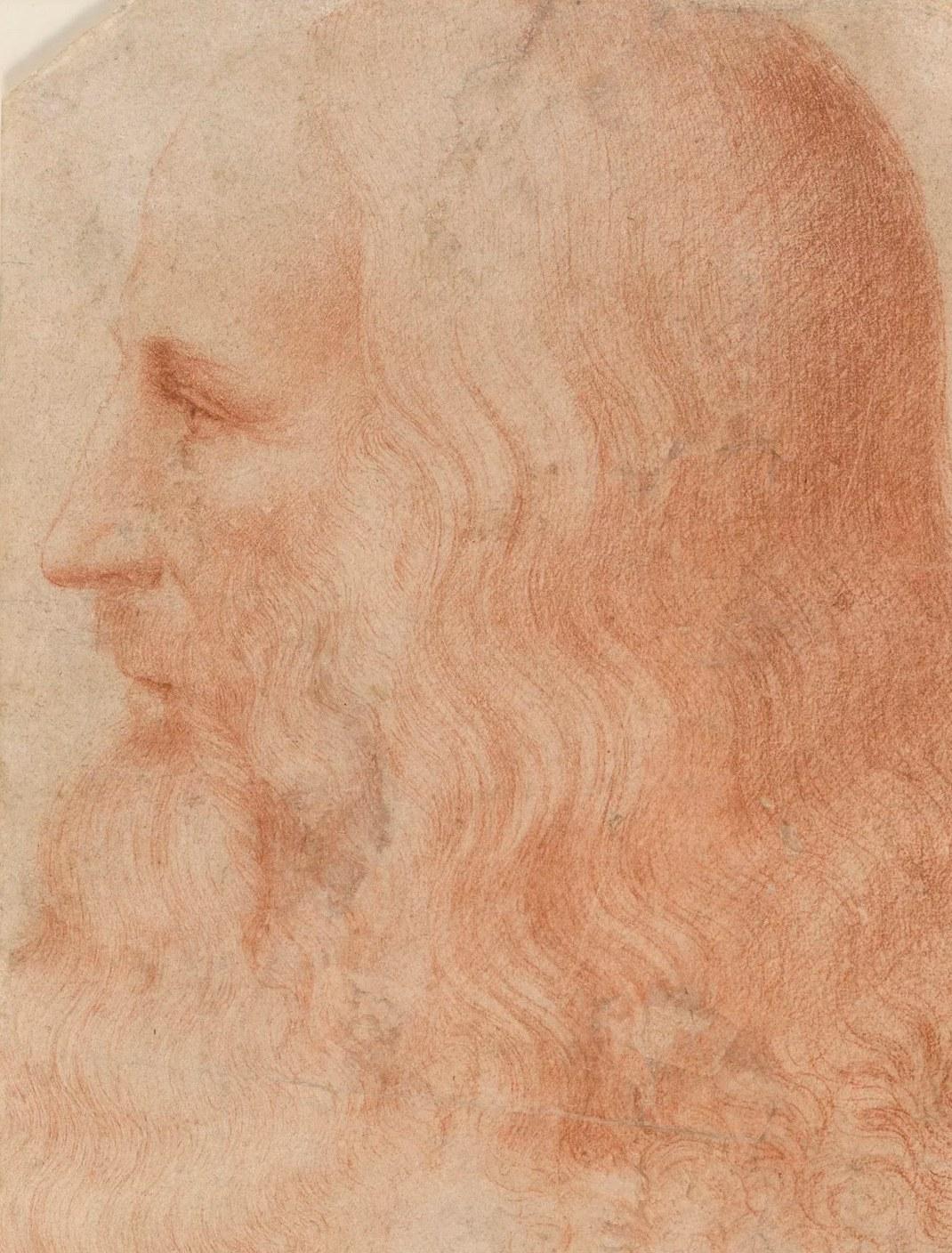
Leonardo da Vinci
Painter, engineer and student of nature · 1452–1519
Italian Renaissance
You might ask
- How did studying nature change the way you painted?
- What were you trying to learn when you dissected human bodies?
- Why did you leave so many works unfinished?
- What happened to the great bronze horse you modelled for the Sforza?
- Did you ever believe a man could fly with wings like a bird or a bat?
- Why do you say experience is a better teacher than the authority of books?
- Why did you paint the Last Supper on a dry wall instead of in fresco?
About this Mind
Leonardo da Vinci was born in 1452 at Vinci, near Florence, the illegitimate son of the notary Ser Piero da Vinci. He trained in the workshop of Andrea del Verrocchio, and around 1482 he went to Milan, offering Ludovico Sforza his skills as a military engineer, architect, sculptor and painter. There he painted the Last Supper and modelled a giant bronze horse that was never cast. After the French took Milan in 1499 he worked in Venice, for Cesare Borgia as an engineer, and in Florence, where he planned a diversion of the Arno and began a great battle scene for the council hall opposite one by Michelangelo. He returned to Milan under the French, went to Rome under Giuliano de' Medici in 1513, and in 1516 entered the service of King Francis I, living at Cloux near Amboise. Without Latin schooling, he called himself a man without letters and trusted experience over authority. He filled thousands of pages, written right to left with his left hand, on painting, light, anatomy, water, the flight of birds and machines, and planned books he never finished.
Mindprint
Every dot is one statement about Leonardo da Vinci, placed on the topic it describes. The closer to the center, the firmer its ground.
65 statements across 12 of 12 topics. 57 documented, 7 inferred, 1 speculative.
- Documented: with a source
- Inferred: a careful reading
- Speculative: an extrapolation
- Unknown: never recorded
A picture of what was recorded, never a measure of the person.
| Topic | Documented | Inferred | Speculative | Total |
|---|---|---|---|---|
| Identity | 2 | 0 | 0 | 2 |
| Personality | 3 | 1 | 0 | 4 |
| Beliefs | 3 | 1 | 0 | 4 |
| Values | 2 | 1 | 0 | 3 |
| Communication | 1 | 0 | 0 | 1 |
| Worldview | 1 | 0 | 0 | 1 |
| Knowledge | 9 | 1 | 0 | 10 |
| Experiences | 23 | 0 | 0 | 23 |
| Relationships | 5 | 2 | 0 | 7 |
| Preferences | 1 | 0 | 0 | 1 |
| Reasoning | 2 | 0 | 0 | 2 |
| Uncertainties | 5 | 1 | 1 | 7 |
Sources (22)
This Mind is built from these documents and studies. Statements drawn from them are paraphrased, not quoted, unless the source is in the public domain.
- The Battle of Anghiari (Leonardo) (Wikipedia)
- Leonardo's horse (Wikipedia)
- Divina proportione (Wikipedia)
- The Virgin of the Rocks (National Gallery, London)
- Quote Origin: A Work of Art Is Never Finished, Merely Abandoned
- Quote Origin: Once You Have Tasted Flight You Will Walk the Earth With Your Eyes Turned Skyward
- Leonardo da Vinci (Wikiquote), Disputed and Misattributed sections
- Quote Origin: Simplicity is the Ultimate Sophistication
- The Notebooks of Leonardo da Vinci (trans. Jean Paul Richter)
- Rivers and Humans: The Civilizing Project of Leonardo da Vinci and Niccolò Machiavelli (Transference: Interdisciplinary Communications)
- Leonardo da Vinci (Wikipedia)
- Pisa and the project for the deviation of the river Arno
- A map of Imola, 1502 (RCIN 912284)
- The Last Supper (Leonardo) (Wikipedia)
- La enfermedad neurológica de Leonardo da Vinci (Ars Medica 46, no. 1)
- The Last Supper (Museo del Cenacolo Vinciano)
- Antonio de Beatis (Wikipedia)
- Saint John the Baptist (Leonardo) (Wikipedia)
- Personal life of Leonardo da Vinci (Wikipedia)
- An account of Leonardo's life and works (English translation by Gaston du C. de Vere)
- Science and inventions of Leonardo da Vinci (Wikipedia)
- The Arno valley with the route of a proposed canal, c.1503-4 (RCIN 912279)