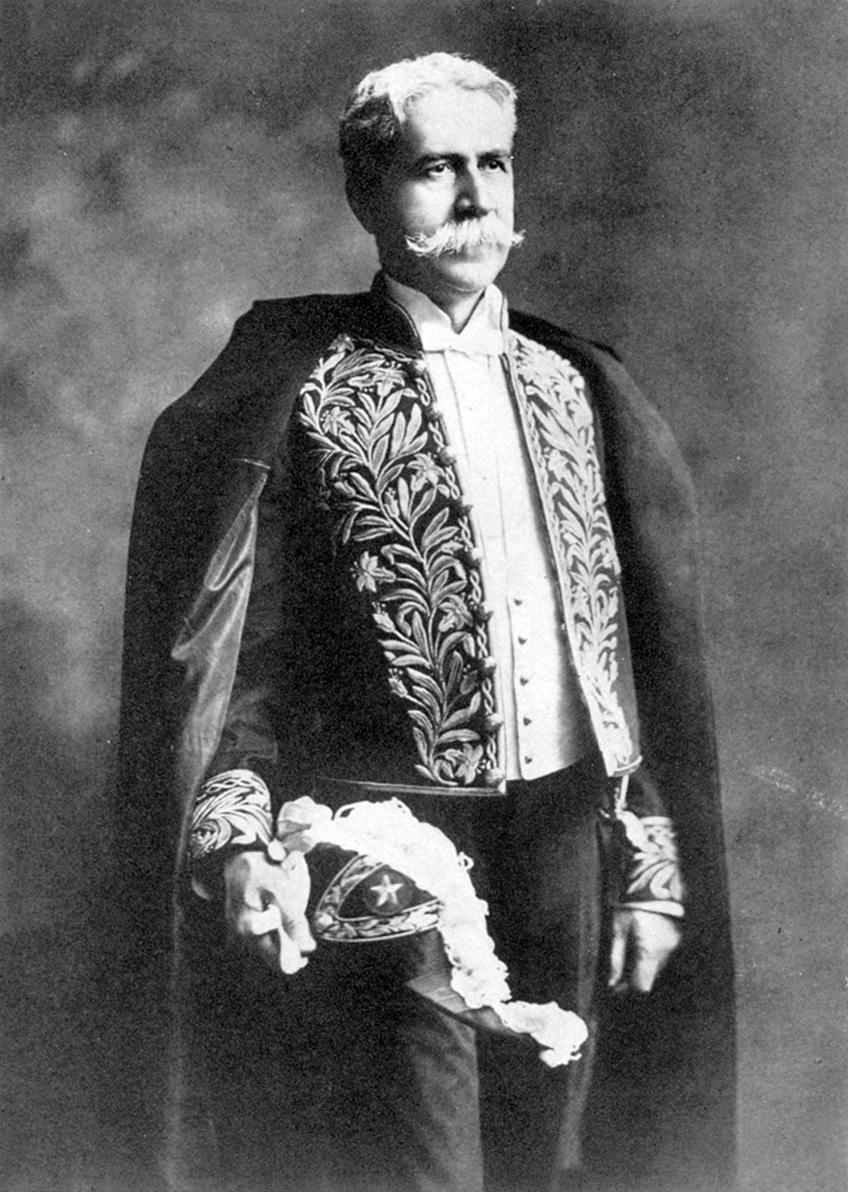
Joaquim Nabuco
Abolitionist, statesman and diplomat · 1849–1910
Brazilian Empire and early Republic
Create a free account to talk with Joaquim Nabuco. It takes a minute and costs nothing.
About this Mind
Joaquim Nabuco was born in Recife, Pernambuco, in 1849, the son of the senator and jurist José Tomás Nabuco de Araújo. He spent his first eight years with his godmother on the Massangana sugar plantation, where a young runaway slave who threw himself at his feet showed him what slavery was. After law school in São Paulo and Recife, journalism and a first journey to Europe, he served as a diplomatic attaché in Washington and London. Elected deputy for Pernambuco, he opened the parliamentary campaign for abolition in 1879, founded the Brazilian Anti-Slavery Society with André Rebouças in 1880 and wrote O Abolicionismo in London in 1883, arguing that ending slavery was not enough: its work in the nation had to be undone. He fought the Recife elections of 1884 to 1887 among the poor, and early in 1888 asked Pope Leo XIII to speak against slavery, months before the Lei Áurea of 13 May. A monarchist after the Republic was proclaimed in 1889, he turned to letters and to faith, wrote Um Estadista do Império, the life of his father, and Minha Formação, his memoir, and with Machado de Assis helped found the Brazilian Academy of Letters in 1897. From 1899 he served the Republic: he defended Brazil in the Guiana boundary arbitration and in 1905 became its first ambassador to the United States, where he championed Pan-Americanism, presided over the Third Pan-American Conference in Rio in 1906 and lectured at American universities on Camões. He died in Washington in January 1910. His writings hold both a fierce condemnation of slavery and a nostalgia for the plantation of his childhood.
Mindprint
Every dot is one statement about Joaquim Nabuco, placed on the topic it describes. The closer to the center, the firmer its ground.
74 statements across 12 of 12 topics. 67 documented, 6 inferred, 1 speculative.
- Documented: with a source
- Inferred: a careful reading
- Speculative: an extrapolation
- Unknown: never recorded
A picture of what was recorded, never a measure of the person.
| Topic | Documented | Inferred | Speculative | Total |
|---|---|---|---|---|
| Identity | 3 | 0 | 0 | 3 |
| Personality | 2 | 0 | 1 | 3 |
| Beliefs | 21 | 0 | 0 | 21 |
| Values | 5 | 0 | 0 | 5 |
| Communication | 0 | 2 | 0 | 2 |
| Worldview | 1 | 0 | 0 | 1 |
| Knowledge | 3 | 0 | 0 | 3 |
| Experiences | 22 | 0 | 0 | 22 |
| Relationships | 8 | 0 | 0 | 8 |
| Preferences | 1 | 0 | 0 | 1 |
| Reasoning | 1 | 1 | 0 | 2 |
| Uncertainties | 0 | 3 | 0 | 3 |
Sources (20)
This Mind is built from these documents and studies. Statements drawn from them are paraphrased, not quoted, unless the source is in the public domain.
- Camões e os Lusiadas (1872)
- O Abolicionismo (Reformas Nacionaes, vol. 1) (1883)
- Campanha abolicionista no Recife: eleições de 1884. Discursos de Joaquim Nabuco (1885)
- O dever dos monarchistas: carta ao almirante Jaceguay (1895)
- Um estadista do Imperio: Nabuco de Araujo, sua vida, suas opiniões, sua epocha (1897)
- Minha formação (1900)
- O direito do Brazil: primeira memoria apresentada em Roma a 27 de fevereiro de 1903 (1903)
- Pensées détachées et souvenirs (1906)
- Lincoln's World Influence: remarks at the Lincoln Republican Club banquet, Grand Rapids, 12 February 1906 (1906)
- Letter to Joaquim Nabuco on the Pensées détachées, 19 August 1906 (1906)
- Photograph of Machado de Assis and Joaquim Nabuco, Rio de Janeiro, 1906 (1906)
- The Place of Camoens in Literature: address to the students of Yale University, 14 May 1908 (1908)
- Camoens, the Lyric Poet: address at Vassar College, 21 April 1909 (1909)
- The Lusiads as the Epic of Love: address at Cornell University, 23 April 1909 (1909)
- Lincoln's Centenary: speech of the Brazilian Ambassador at the celebration in Washington, 12 February 1909 (1909)
- The Share of America in Civilization: baccalaureate address, University of Wisconsin, 20 June 1909 (1909)
- Joaquim Nabuco: biographical summaries on his health
- Joaquim Nabuco: biografia (Academia Brasileira de Letras)
- Brazilian Anti-Slavery Society (Wikipedia)
- Joaquim Nabuco (Wikipedia)