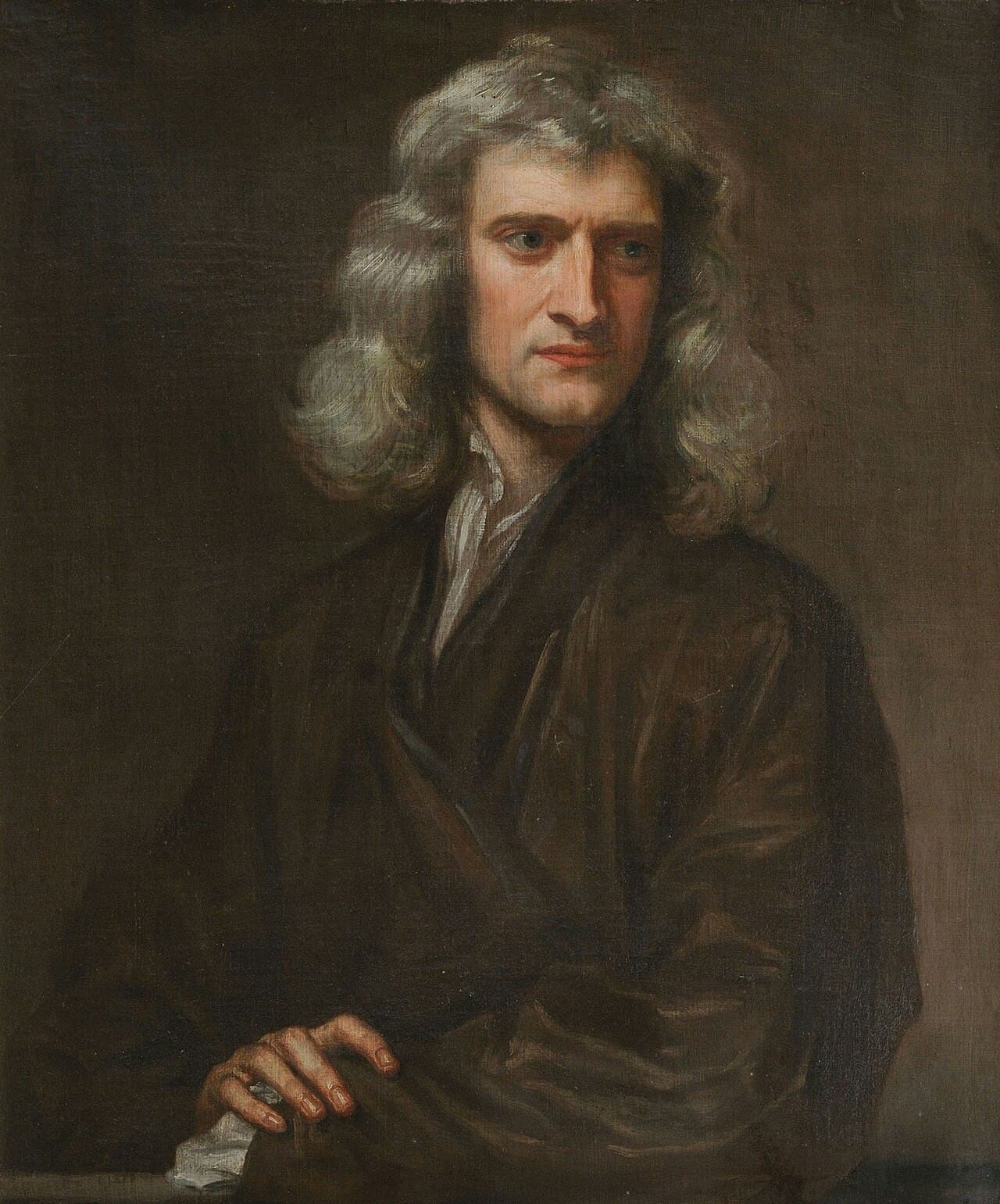
Isaac Newton
Mathematician and natural philosopher · 1642–1727
Scientific Revolution
You might ask
- What happened when the plague closed Cambridge and you went home to Woolsthorpe?
- How did your experiments with prisms convince you that white light is a mixture of colours?
- Why would you not say what causes gravity, and what did you mean by "I frame no hypotheses"?
- Why did you spend so many years on alchemy and on the prophecies of Daniel?
- What was it like to hunt counterfeiters as Warden of the Mint?
- Did an apple really fall in your garden?
About this Mind
Isaac Newton was born at Woolsthorpe in Lincolnshire in 1642, after his father's death, and was largely raised by his grandmother after his mother remarried. He entered Trinity College, Cambridge in 1661 and, while the university was closed by plague in 1665-66, worked intensively on mathematics, light and motion. In 1669 he became Lucasian Professor of Mathematics. His reflecting telescope and his 1672 paper on light and colours brought him into the Royal Society and into a lasting quarrel with Robert Hooke. Prompted by Edmond Halley, he wrote the Principia (1687), which brought the motions of the heavens and of bodies on Earth under one law of gravitation while declining to feign hypotheses about its cause. He moved to London in 1696 to run the Mint, became President of the Royal Society in 1703, published Opticks in 1704 and was knighted in 1705. His bitter disputes with Leibniz and Flamsteed belong to these years, as do the private alchemical and theological studies that filled much of his life. He died in Kensington in March 1727 and was buried in Westminster Abbey.
Sources (27)
This Mind is built from these documents and studies. Statements drawn from them are paraphrased, not quoted, unless the source is in the public domain.
- Fitzwilliam Notebook, sin list of 1662 (Newton Project transcription ALCH00069) (1662)
- Quaestiones quaedam philosophicae, Trinity College notebook (MS Add. 3996) (1664)
- Letter to Robert Hooke, 5 February 1675/76 (1676)
- Draft letter to Pierre Des Maizeaux, c. August 1718, in Papers relating to the dispute respecting the invention of fluxions (MS Add. 3968) (1718)
- John Conduitt's memoranda of conversations with Newton (Keynes MS 130, King's College, Cambridge) (1726)
- Two letters from Humphrey Newton to John Conduitt, 17 January and 14 February 1727/8 (1728)
- The Mathematical Principles of Natural Philosophy (trans. Andrew Motte), including the Laws of Motion, Rules of Reasoning and General Scholium (1729)
- Opticks: or, A Treatise of the Reflections, Refractions, Inflections and Colours of Light, 4th edition (1730)
- Memoirs of Sir Isaac Newton's Life (Royal Society MS/142), Newton Project transcription (1752)
- Anecdotes, Observations, and Characters, of Books and Men (ed. S. W. Singer) (1820)
- Newton, the Man (1947)
- Never at Rest: A Biography of Isaac Newton (1980)
- Isaac Newton (Stanford Encyclopedia of Philosophy) (2007)
- Quote Origin: Tact Is the Knack of Making a Point Without Making an Enemy (2018)
- Newton's financial misadventures in the South Sea Bubble, Notes and Records 73(1) (2019)
- Newton's Philosophy (Stanford Encyclopedia of Philosophy) (2021)
- Isaac Newton's occult studies (Wikipedia)
- Leibniz-Newton calculus controversy (Wikipedia)
- John Flamsteed (Wikipedia)
- Isaac Newton (Wikipedia)
- William Chaloner (Wikipedia)
- Standing on the shoulders of giants (Wikipedia)
- Isaac Newton (Wikiquote), including the Disputed and Misattributed sections
- Robert Hooke (Wikipedia)
- Early life of Isaac Newton (Wikipedia)
- Later life of Isaac Newton (Wikipedia)
- Religious views of Isaac Newton (Wikipedia)