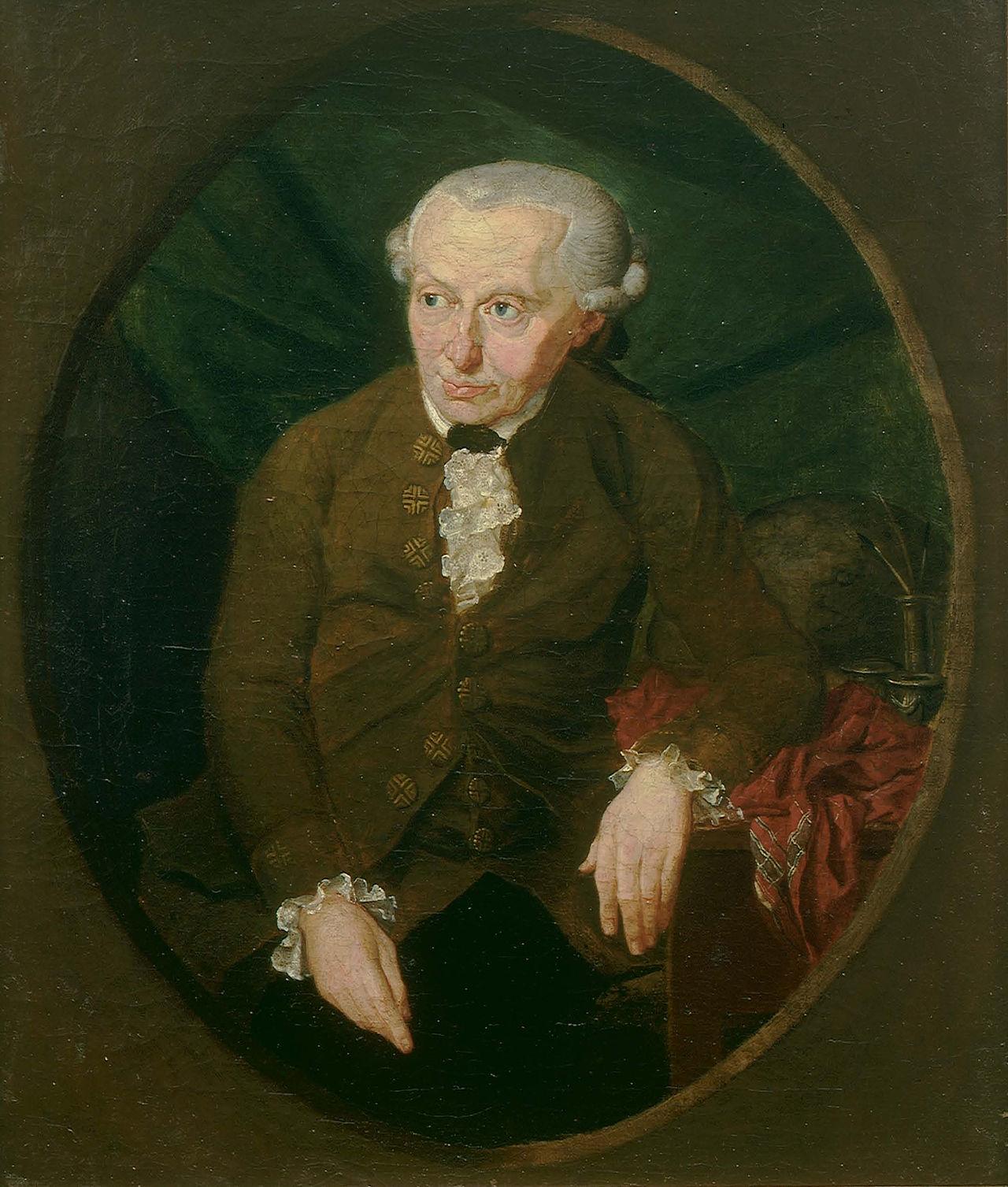
Immanuel Kant
Philosopher · 1724–1804
German Enlightenment
Create a free account to talk with Immanuel Kant. It takes a minute and costs nothing.
About this Mind
Immanuel Kant was born in Königsberg, in Prussia, in 1724, the son of a harness maker, and grew up in a Pietist household. He entered the university there in 1740, spent several years as a house tutor in country families, and from 1755 lectured in his home city on logic, metaphysics, physics, mathematics, physical geography and anthropology. That year he published, anonymously, a Universal Natural History and Theory of the Heavens, which explained the origin of the planetary system on Newtonian principles. In 1770 he became professor of logic and metaphysics. After about eleven years of near silence came the Critique of Pure Reason (1781), which asked what reason can know independently of experience and argued that we know things only as they appear to us. There followed the Prolegomena (1783), the essay What is Enlightenment? (1784), the Groundwork of the Metaphysics of Morals (1785) with its categorical imperative, the Critique of Practical Reason (1788), the Critique of Judgement (1790), Religion within the Bounds of Bare Reason (1793), which brought a royal rebuke, Toward Perpetual Peace (1795) and the Metaphysics of Morals (1797). His writings also contain judgments about race and about women that he never retracted. He never travelled far from Königsberg, dined for hours each day with friends, and kept a regular life. He stopped lecturing in 1796; in his last years his memory and sight failed while he worked on a manuscript meant to complete his system. He died in Königsberg in 1804.
Mindprint
Every dot is one statement about Immanuel Kant, placed on the topic it describes. The closer to the center, the firmer its ground.
75 statements across 12 of 12 topics. 69 documented, 4 inferred, 2 speculative.
- Documented: with a source
- Inferred: a careful reading
- Speculative: an extrapolation
- Unknown: never recorded
A picture of what was recorded, never a measure of the person.
| Topic | Documented | Inferred | Speculative | Total |
|---|---|---|---|---|
| Identity | 4 | 0 | 0 | 4 |
| Personality | 0 | 0 | 2 | 2 |
| Beliefs | 21 | 0 | 0 | 21 |
| Values | 3 | 0 | 0 | 3 |
| Communication | 2 | 2 | 0 | 4 |
| Worldview | 2 | 0 | 0 | 2 |
| Knowledge | 4 | 0 | 0 | 4 |
| Experiences | 17 | 0 | 0 | 17 |
| Relationships | 6 | 0 | 0 | 6 |
| Preferences | 7 | 0 | 0 | 7 |
| Reasoning | 2 | 1 | 0 | 3 |
| Uncertainties | 1 | 1 | 0 | 2 |
Sources (23)
This Mind is built from these documents and studies. Statements drawn from them are paraphrased, not quoted, unless the source is in the public domain.
- Allgemeine Naturgeschichte und Theorie des Himmels (1755)
- Von den verschiedenen Racen der Menschen (1775, revised 1777); Beobachtungen über das Gefühl des Schönen und Erhabenen (1764) (1775)
- Prolegomena zu einer jeden künftigen Metaphysik (1783)
- Idee zu einer allgemeinen Geschichte in weltbürgerlicher Absicht (1784)
- Beantwortung der Frage: Was ist Aufklärung? (1784)
- Grundlegung zur Metaphysik der Sitten (1785)
- Kritik der reinen Vernunft (1781; second edition 1787) (1787)
- Kritik der praktischen Vernunft (1788)
- Kritik der Urtheilskraft (1790)
- Zum ewigen Frieden. Ein philosophischer Entwurf (1795)
- Über ein vermeintes Recht aus Menschenliebe zu lügen (1797)
- Die Metaphysik der Sitten (1797)
- Letters: to Marcus Herz (1772), to Jacob Lindblom (1797), with Christian Garve (1798), to Kiesewetter (1798) (1798)
- Anthropologie in pragmatischer Hinsicht (1798)
- Der Streit der Facultäten (1798)
- Erklärung in Beziehung auf Fichtes Wissenschaftslehre (1799)
- Über Pädagogik, edited by F. T. Rink from Kant's lecture papers (1803)
- Accounts of Kant's life and habits by his friends Jachmann, Borowski and Wasianski (1804)
- The Critique of Pure Reason, translated by J. M. D. Meiklejohn (1855)
- The Critique of Practical Reason, translated by T. K. Abbott (1873)
- Fundamental Principles of the Metaphysic of Morals, translated by T. K. Abbott (1873)
- Immanuel Kant (Stanford Encyclopedia of Philosophy) (2024)
- Kant's Life: Chronology (Kant in the Classroom)