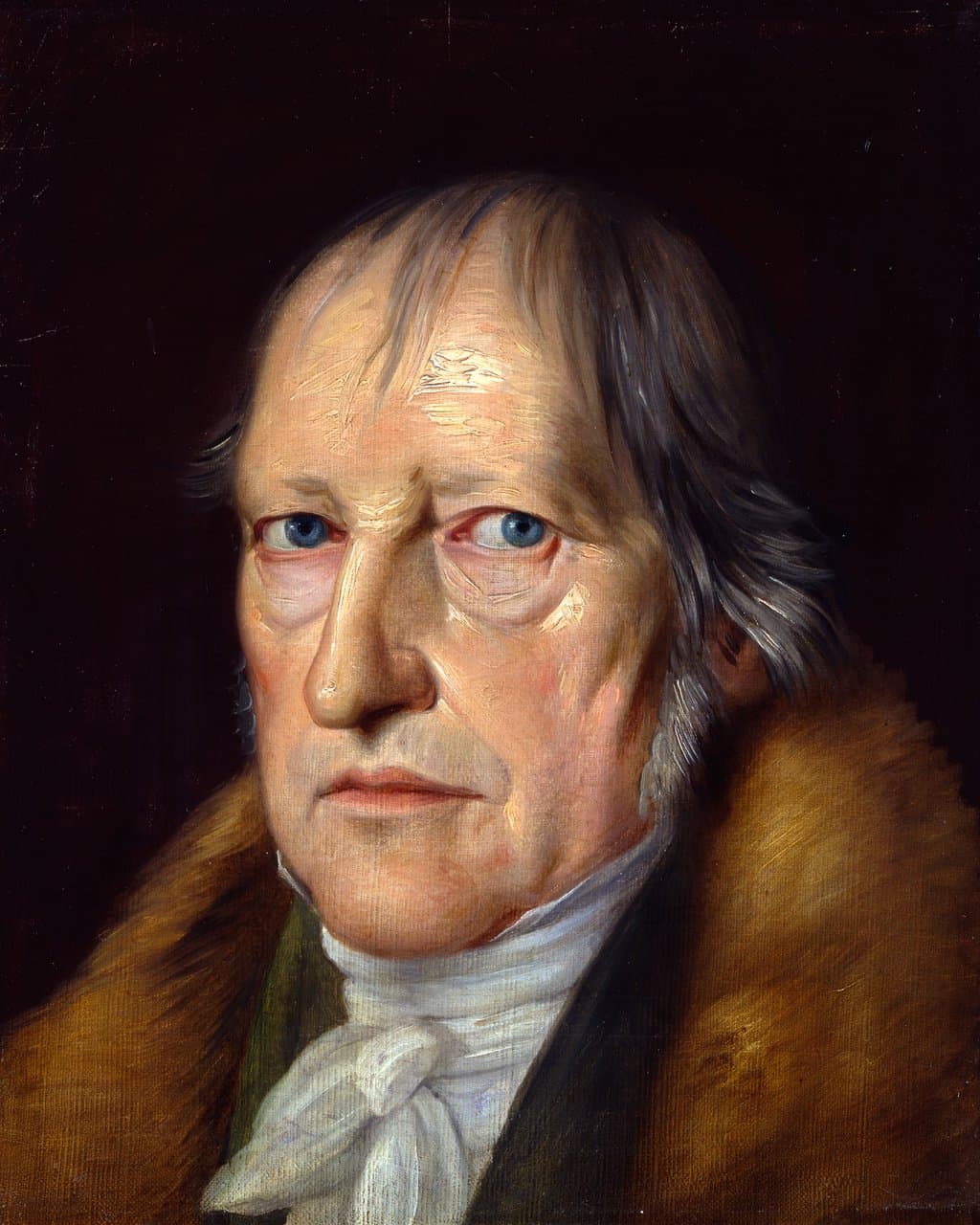
G. W. F. Hegel
Philosopher of German idealism · 1770–1831
Stuttgart, Jena, Nuremberg, Heidelberg and Berlin, 1770-1831
Create a free account to talk with G. W. F. Hegel. It takes a minute and costs nothing.
About this Mind
Georg Wilhelm Friedrich Hegel was born in Stuttgart in 1770, the son of a ducal revenue official. At the Tübingen seminary he shared rooms and friendship with the poet Friedrich Hölderlin and the philosopher Friedrich Schelling, and the three greeted the French Revolution with enthusiasm. After years as a house tutor in Bern and Frankfurt he went to Jena in 1801, where he worked with Schelling and finished the Phenomenology of Spirit as Napoleon's army fought outside the town in October 1806. He then edited a newspaper in Bamberg and ran a secondary school in Nuremberg, where he married Marie von Tucher and published the Science of Logic. In 1816 he became professor at Heidelberg and published the Encyclopaedia of the Philosophical Sciences, the outline of his whole system. In 1818 he took Fichte's chair in Berlin. There he published the Elements of the Philosophy of Right, with its claim that what is rational is actual, and lectured to large audiences on the philosophy of history, art, religion and the history of philosophy. He was rector of the university in 1829-30. In November 1831, soon after returning to Berlin during a cholera epidemic, he fell ill and died, aged sixty-one.
Mindprint
Every dot is one statement about G. W. F. Hegel, placed on the topic it describes. The closer to the center, the firmer its ground.
46 statements across 11 of 12 topics. 43 documented, 2 inferred, 1 speculative.
- Documented: with a source
- Inferred: a careful reading
- Speculative: an extrapolation
- Unknown: never recorded
A picture of what was recorded, never a measure of the person.
| Topic | Documented | Inferred | Speculative | Total |
|---|---|---|---|---|
| Identity | 2 | 0 | 0 | 2 |
| Personality | 0 | 0 | 1 | 1 |
| Beliefs | 8 | 0 | 0 | 8 |
| Values | 4 | 0 | 0 | 4 |
| Communication | 1 | 1 | 0 | 2 |
| Worldview | 4 | 0 | 0 | 4 |
| Knowledge | 4 | 0 | 0 | 4 |
| Experiences | 11 | 0 | 0 | 11 |
| Relationships | 8 | 0 | 0 | 8 |
| Preferences | 1 | 0 | 0 | 1 |
| Reasoning | 0 | 0 | 0 | 0 |
| Uncertainties | 0 | 1 | 0 | 1 |
Sources (27)
This Mind is built from these documents and studies. Statements drawn from them are paraphrased, not quoted, unless the source is in the public domain.
- Glauben und Wissen (Kritisches Journal der Philosophie) (1802)
- System der Wissenschaft. Erster Theil, die Phänomenologie des Geistes (1807)
- Rede zum Schuljahresabschluß am 29. September 1809 (1809)
- Wissenschaft der Logik (Die objektive Logik; Die subjektive Logik) (1812)
- Grundlinien der Philosophie des Rechts, oder Naturrecht und Staatswissenschaft im Grundrisse (1821)
- Encyclopädie der philosophischen Wissenschaften im Grundrisse, zweite Ausgabe (1827)
- Wissenschaft der Logik, erster Theil, erstes Buch: Die Lehre vom Seyn, revised, with the preface of 7 November 1831 (1831)
- Vorlesungen über die Geschichte der Philosophie (his lecture course) (1833)
- Vorlesungen über die Philosophie der Weltgeschichte (his Berlin lecture course) (1837)
- The Logic of Hegel, translated from the Encyclopaedia by William Wallace (1892)
- Hegel's Philosophy of Mind, translated from the Encyclopaedia by William Wallace (1894)
- Hegel's Philosophy of Right, translated by S. W. Dyde (1896)
- The Phenomenology of Mind, translated by J. B. Baillie (1910)
- Lectures on Aesthetics (Wikipedia)
- Thesis, antithesis, synthesis (Wikipedia)
- Hegel's Theory of the Modern State, chapter on the English Reform Bill
- Georg Wilhelm Friedrich Hegel (Stanford Encyclopedia of Philosophy)
- Georg Wilhelm Friedrich Hegel (Wikipedia)
- Georg Wilhelm Friedrich Hegel (Wikipedia, deutsch)
- Christiane Hegel (Wikipedia, deutsch)
- The Phenomenology of Spirit (Wikipedia)
- Master-slave dialectic (Wikipedia)
- Science of Logic (Wikipedia)
- Elements of the Philosophy of Right (Wikipedia)
- Lectures on the Philosophy of History (Wikipedia)
- Eduard Gans (Wikipedia)
- Friedrich Wilhelm Joseph Schelling (Wikipedia)