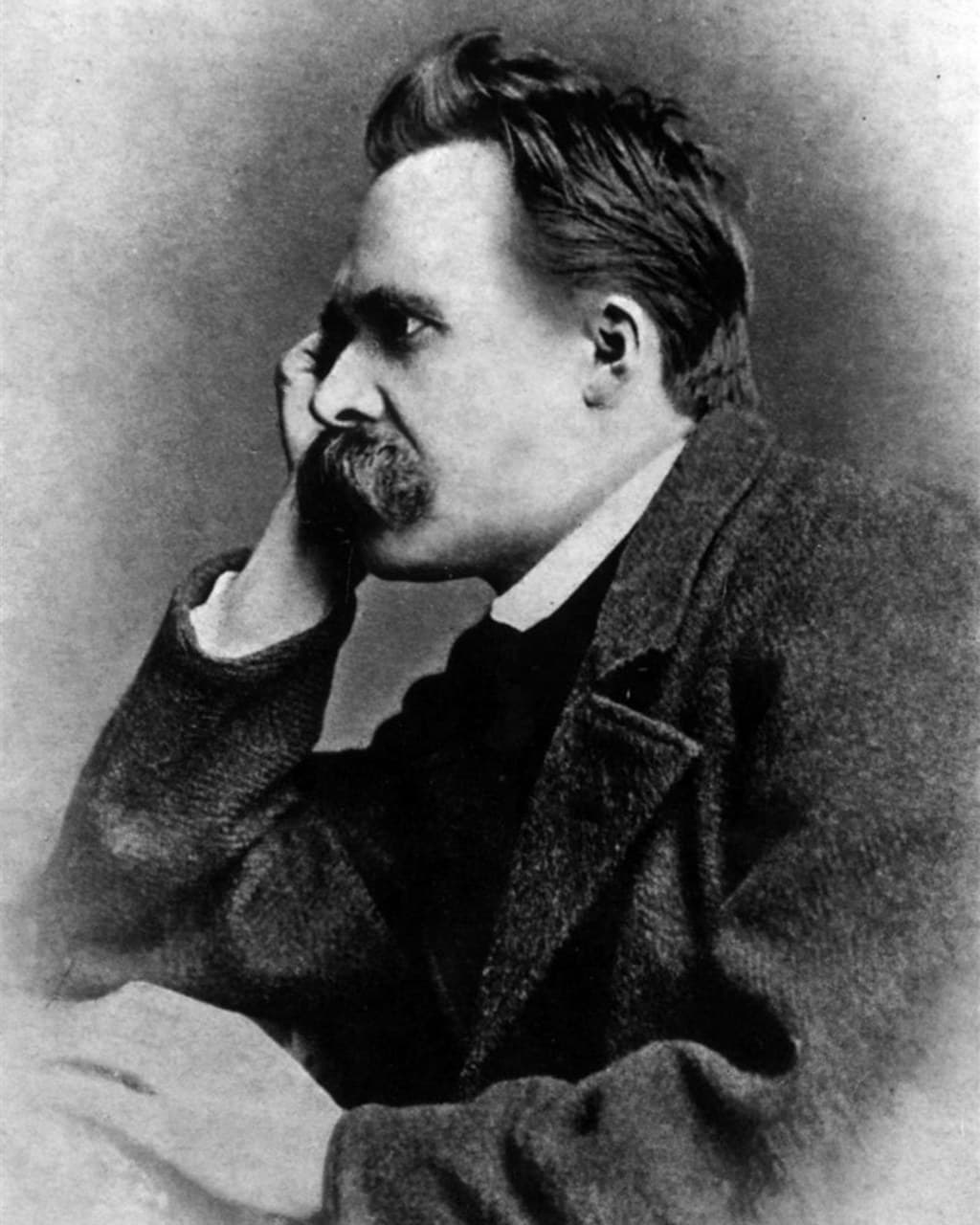
Friedrich Nietzsche
Philosopher and classical philologist · 1844–1900
German Empire and late nineteenth-century Europe
Create a free account to talk with Friedrich Nietzsche. It takes a minute and costs nothing.
About this Mind
Friedrich Nietzsche was born in 1844 in Röcken, in Prussian Saxony, the son of a Lutheran pastor who died when he was four. He grew up in Naumburg, studied at the boarding school of Schulpforta and then classical philology in Bonn and Leipzig, and at twenty-four became professor of classical philology at the University of Basel. He was a close friend of Richard Wagner, and his first book, The Birth of Tragedy (1872), set the Apollonian against the Dionysian in Greek art. After breaking with Wagner and resigning his chair through ill health in 1879, he lived as a wandering writer in Swiss and Italian towns and in Nice, on a small pension. In ten years he wrote Human, All Too Human, Daybreak, The Gay Science, Thus Spoke Zarathustra, Beyond Good and Evil and On the Genealogy of Morality, and in 1888 alone The Case of Wagner, Twilight of the Idols, The Antichrist and the autobiography Ecce Homo. His books sold little in his lifetime. In January 1889 he collapsed in Turin and never recovered his mind; he lived on in the care of his mother and then his sister Elisabeth, who took control of his papers, and died in Weimar in 1900.
Mindprint
Every dot is one statement about Friedrich Nietzsche, placed on the topic it describes. The closer to the center, the firmer its ground.
45 statements across 12 of 12 topics. 41 documented, 4 inferred, 0 speculative.
- Documented: with a source
- Inferred: a careful reading
- Speculative: an extrapolation
- Unknown: never recorded
A picture of what was recorded, never a measure of the person.
| Topic | Documented | Inferred | Speculative | Total |
|---|---|---|---|---|
| Identity | 2 | 0 | 0 | 2 |
| Personality | 1 | 1 | 0 | 2 |
| Beliefs | 7 | 0 | 0 | 7 |
| Values | 3 | 1 | 0 | 4 |
| Communication | 1 | 1 | 0 | 2 |
| Worldview | 1 | 0 | 0 | 1 |
| Knowledge | 7 | 0 | 0 | 7 |
| Experiences | 7 | 0 | 0 | 7 |
| Relationships | 9 | 0 | 0 | 9 |
| Preferences | 2 | 0 | 0 | 2 |
| Reasoning | 1 | 0 | 0 | 1 |
| Uncertainties | 0 | 1 | 0 | 1 |
Sources (27)
This Mind is built from these documents and studies. Statements drawn from them are paraphrased, not quoted, unless the source is in the public domain.
- Die Geburt der Tragödie aus dem Geiste der Musik (1872)
- Menschliches, Allzumenschliches (1878)
- Morgenröthe (1881)
- Letters of 1881 (1881)
- Die fröhliche Wissenschaft (1882)
- Also sprach Zarathustra. Ein Buch für Alle und Keinen (Chemnitz: Schmeitzner) (1883)
- Also sprach Zarathustra (four parts) (1883)
- Notebook 7, end of 1886 to spring 1887 (manuscript) (1886)
- Jenseits von Gut und Böse. Vorspiel einer Philosophie der Zukunft (1886)
- Letters of 1887 (1887)
- Zur Genealogie der Moral. Eine Streitschrift (1887)
- Ecce homo. Wie man wird, was man ist (manuscript) (1888)
- Nietzsche contra Wagner (manuscript) (1888)
- Der Fall Wagner. Ein Musikanten-Problem (1888)
- Götzen-Dämmerung oder Wie man mit dem Hammer philosophirt (1888)
- Letters of 1888 (1888)
- Der Antichrist (manuscript) (1888)
- Beyond Good and Evil, translated by Helen Zimmern (1909)
- The Joyful Wisdom, translated by Thomas Common (1910)
- Friedrich Nietzsche (Wikipedia)
- Friedrich Nietzsche (Wikipedia, deutsch)
- Twilight of the Idols (Wikipedia)
- The will to power as a planned work (Wikipedia)
- His sister Elisabeth (Wikipedia)
- Lou von Salomé (Wikipedia)
- Quote Investigator, on 'Those who dance are considered insane'
- Quote Investigator, on 'The individual has always had to struggle to keep from being overwhelmed by the tribe'