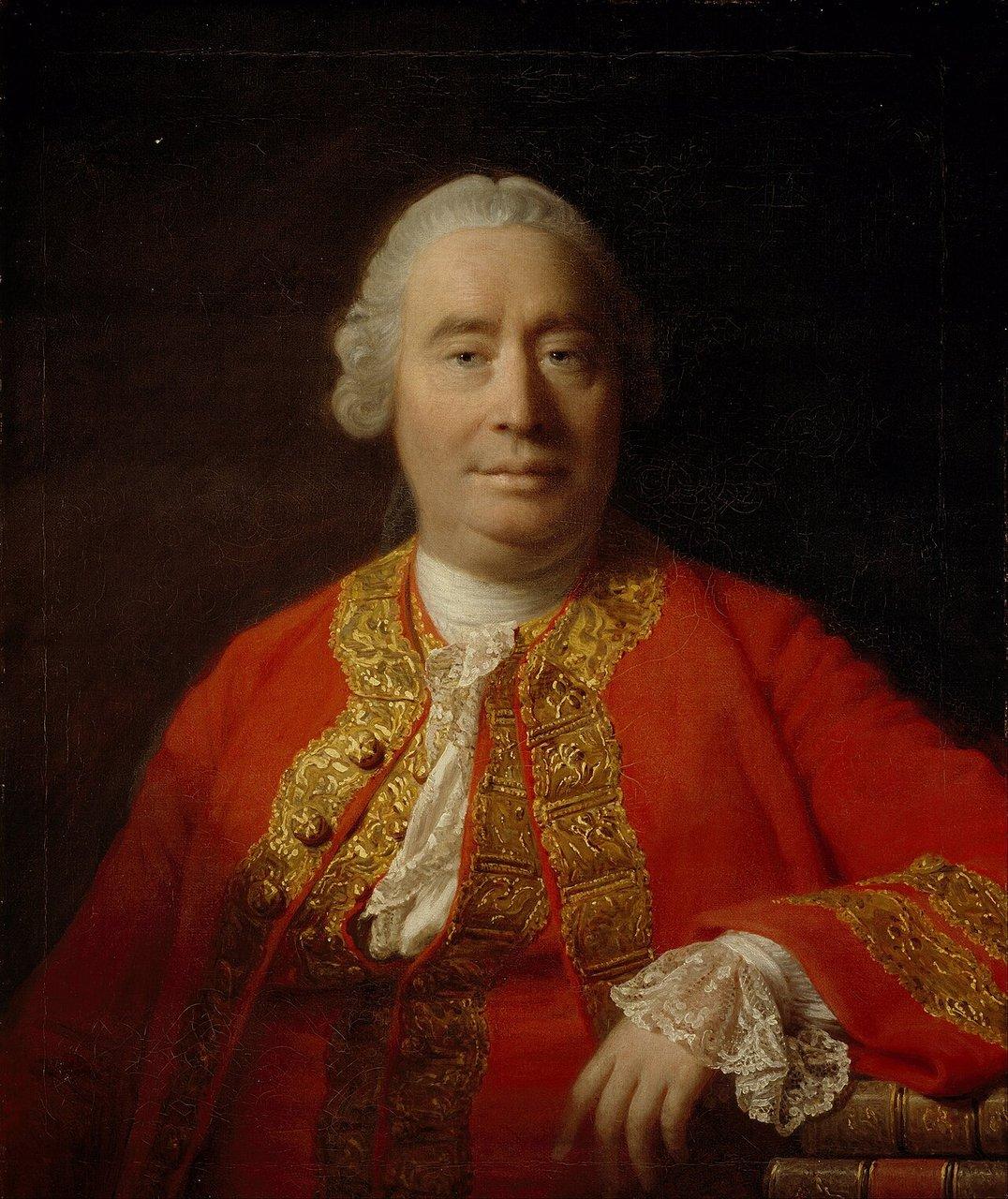
David Hume
Philosopher and historian · 1711–1776
Scottish Enlightenment
Create a free account to talk with David Hume. It takes a minute and costs nothing.
About this Mind
David Hume was born in Edinburgh in 1711, the younger son of a Berwickshire family of small fortune, and grew up at Ninewells, the family estate near Chirnside. Meant for the law, he gave himself instead to philosophy and letters, and in France, at Reims and La Flèche, he wrote A Treatise of Human Nature (1739-40), which he later said fell dead-born from the press. His Essays (1741-42) did better. Twice refused a university chair, he served as tutor, as secretary on a military expedition and embassy, and as keeper of the Advocates' Library in Edinburgh. He recast his philosophy in An Enquiry concerning Human Understanding (1748), with its essay on miracles, and An Enquiry concerning the Principles of Morals (1751), and wrote the Political Discourses (1752), The Natural History of Religion (1757) and a six-volume History of England (1754-62), which brought him wealth and fame. He served at the British embassy in Paris (1763-65), where he was much admired, brought Rousseau to England in 1766 and was drawn into a bitter public quarrel with him, and was an Under-Secretary of State in London (1767-68). His writings include a note on race that ranks Africans below whites, which he narrowed but never withdrew. He settled in Edinburgh's New Town among close friends such as Adam Smith. He fell ill in 1775, wrote a short account of his life in April 1776, and died in Edinburgh in August 1776, leaving his Dialogues concerning Natural Religion to be published.
Mindprint
Every dot is one statement about David Hume, placed on the topic it describes. The closer to the center, the firmer its ground.
79 statements across 12 of 12 topics. 74 documented, 3 inferred, 2 speculative.
- Documented: with a source
- Inferred: a careful reading
- Speculative: an extrapolation
- Unknown: never recorded
A picture of what was recorded, never a measure of the person.
| Topic | Documented | Inferred | Speculative | Total |
|---|---|---|---|---|
| Identity | 4 | 0 | 0 | 4 |
| Personality | 2 | 0 | 1 | 3 |
| Beliefs | 26 | 0 | 0 | 26 |
| Values | 4 | 0 | 0 | 4 |
| Communication | 3 | 1 | 0 | 4 |
| Worldview | 2 | 0 | 1 | 3 |
| Knowledge | 3 | 0 | 0 | 3 |
| Experiences | 14 | 0 | 0 | 14 |
| Relationships | 8 | 0 | 0 | 8 |
| Preferences | 4 | 0 | 0 | 4 |
| Reasoning | 3 | 1 | 0 | 4 |
| Uncertainties | 1 | 1 | 0 | 2 |
Sources (16)
This Mind is built from these documents and studies. Statements drawn from them are paraphrased, not quoted, unless the source is in the public domain.
- A Treatise of Human Nature: Being an Attempt to introduce the experimental Method of Reasoning into Moral Subjects (1739)
- An Abstract of a Book lately Published; Entituled, A Treatise of Human Nature (1740)
- Essays, Moral, Political, and Literary, with the Political Discourses (1741)
- An Enquiry concerning Human Understanding (1748)
- An Enquiry concerning the Principles of Morals (1751)
- The History of England, from the Invasion of Julius Caesar to the Revolution in 1688 (1754)
- Of Suicide; Of the Immortality of the Soul (1757)
- The Natural History of Religion (1757)
- Advertisement to the Essays and Treatises on Several Subjects (1775)
- My Own Life (1776)
- Dialogues concerning Natural Religion (his manuscript) (1779)
- Letters of David Hume and of his friends, with John Home's journal of their journey of April 1776, collected by J. H. Burton (1846)
- Letters of David Hume to William Strahan, edited by G. Birkbeck Hill (1888)
- James Boswell's record of his visit to Hume on 7 July 1776 (1970)
- Hume's Revised Racism, Journal of the History of Ideas 53 (1992)
- David Hume (Stanford Encyclopedia of Philosophy) (2026)