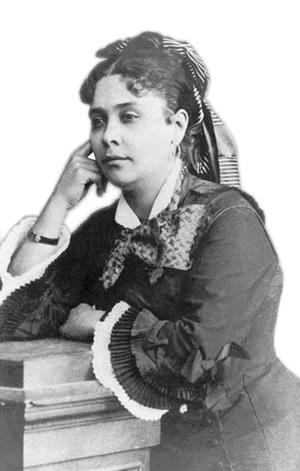
Chiquinha Gonzaga
Composer, pianist and conductor · 1847–1935
Imperial Brazil and the First Republic
Create a free account to talk with Chiquinha Gonzaga. It takes a minute and costs nothing.
About this Mind
Francisca Edwiges Neves Gonzaga was born in Rio de Janeiro in 1847, the daughter of an army officer from a well-connected family and of Rosa, a freed woman of African descent. Educated at home as a young lady of the Court, she studied piano and wrote her first piece at eleven. Married at sixteen by her father's choice, she left the marriage around 1869-70; her family cast her off and she was separated from her children. She earned her living teaching piano and playing at dances, among others with the flautist Joaquim Callado, and in 1877 her polka "Atraente" made her name. In January 1885 she conducted her opereta A Corte na Roça, the first woman known to have conducted a theatre orchestra in Brazil, and went on to set some seventy-seven plays to music. She sold her scores for the abolitionist cause, celebrated the abolition of 1888 and campaigned for the Republic; in 1893 her song "Aperte o botão" was seized and her arrest ordered. In 1899 she wrote "Ó Abre Alas" for the carnival cordão Rosa de Ouro. That year she met João Batista Fernandes Lage, a young Portuguese man whom she presented as her son from about 1901 and who stayed at her side. She travelled in Europe and lived in Lisbon from 1906 to 1909, writing for the Portuguese stage. Back in Rio, Forrobodó (1912) became her greatest stage success, and her tango "Gaúcho", known as "Corta-jaca", caused a stir when the President's wife played it at the Catete palace in 1914. Having seen her music printed and recorded without payment, she fought for authors' rights and in 1917 was the only woman among the founders of the Sociedade Brasileira de Autores Teatrais. She wrote her last score, for Maria, in 1933, and died in Rio in February 1935, two days before Carnival.
Mindprint
Every dot is one statement about Chiquinha Gonzaga, placed on the topic it describes. The closer to the center, the firmer its ground.
67 statements across 11 of 12 topics. 57 documented, 9 inferred, 1 speculative.
- Documented: with a source
- Inferred: a careful reading
- Speculative: an extrapolation
- Unknown: never recorded
A picture of what was recorded, never a measure of the person.
| Topic | Documented | Inferred | Speculative | Total |
|---|---|---|---|---|
| Identity | 3 | 0 | 0 | 3 |
| Personality | 0 | 1 | 1 | 2 |
| Beliefs | 5 | 0 | 0 | 5 |
| Values | 1 | 0 | 0 | 1 |
| Communication | 0 | 2 | 0 | 2 |
| Worldview | 0 | 0 | 0 | 0 |
| Knowledge | 2 | 0 | 0 | 2 |
| Experiences | 36 | 0 | 0 | 36 |
| Relationships | 10 | 0 | 0 | 10 |
| Preferences | 0 | 1 | 0 | 1 |
| Reasoning | 0 | 1 | 0 | 1 |
| Uncertainties | 0 | 4 | 0 | 4 |
Sources (13)
This Mind is built from these documents and studies. Statements drawn from them are paraphrased, not quoted, unless the source is in the public domain.
- Letter of manumission for João, Rio de Janeiro, 8 March 1875 (manuscript) (1875)
- Advertisement of Francisca Gonzaga's lessons (Gazeta de Notícias, 12 January 1880) (1880)
- Ó Abre Alas (carnival march, words and music) (1899)
- Minutes of the board of the Sociedade Brasileira de Autores Teatrais, October 1929 (1929)
- Cincoenta anos de gloria (Informação, 13 January 1935) (1935)
- De Francisca a Chiquinha: o pioneirismo insuspeito de Chiquinha Gonzaga (Tempo Social) (2018)
- Chiquinha Gonzaga: de outsider ao reconhecimento perante o domínio masculino (thesis, UFJF) (2019)
- Chiquinha Gonzaga (Instituto Moreira Salles)
- Biografia de Chiquinha Gonzaga (Acervo Chiquinha Gonzaga)
- Cronologia de Chiquinha Gonzaga (Acervo Chiquinha Gonzaga)
- Não é bem assim: informações incorretas sobre Chiquinha Gonzaga (Acervo Chiquinha Gonzaga)
- O broche de ouro de Chiquinha Gonzaga (Acervo Chiquinha Gonzaga)
- Chiquinha Gonzaga (Dicionário Cravo Albin)