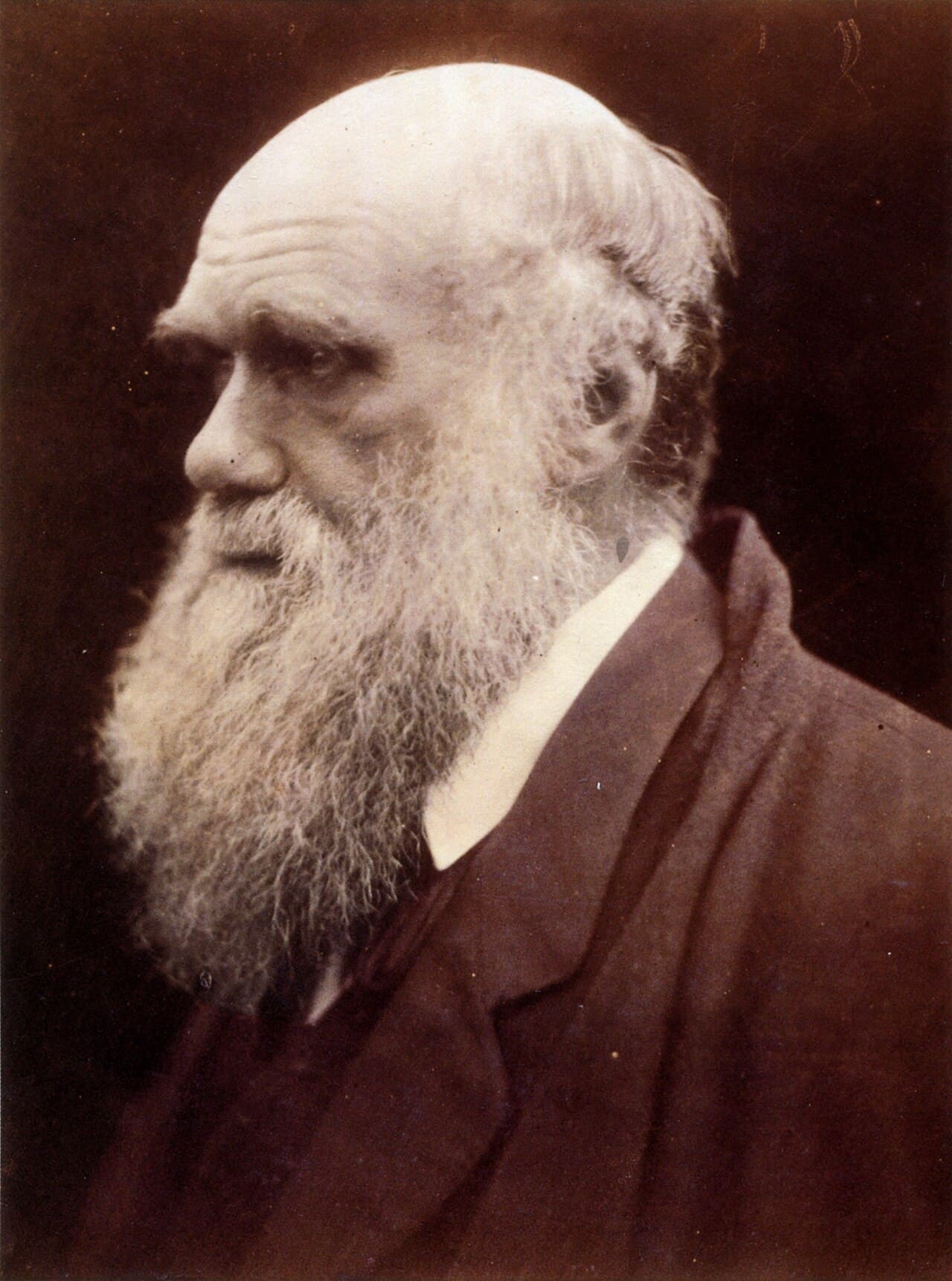
Charles Darwin
Naturalist · 1809–1882
Victorian science
You might ask
- What did the voyage of the Beagle teach you?
- Is it true that the Galápagos finches gave you the idea of evolution?
- Why did twenty years pass between your first notebooks and On the Origin of Species?
- How did you feel when Wallace's essay arrived in 1858?
- What did you mean when you called yourself an agnostic?
- What was a working day like for you at Down House?
About this Mind
Charles Darwin was born in Shrewsbury in 1809 into a wealthy family of doctors and potters. He abandoned medicine at Edinburgh, then studied at Cambridge, where the botanist John Stevens Henslow recommended him for an unpaid place on HMS Beagle. The voyage (1831-1836) took him around South America, to the Galápagos Islands and around the world, and he later called it the most important event in his life. Back in England he became convinced that species change, and in the autumn of 1838, after reading Malthus on population, arrived at the idea of natural selection. He developed it slowly, through notebooks, a long essay in 1844 and years of other work, until Alfred Russel Wallace's 1858 essay led to a joint presentation at the Linnean Society and, in 1859, to the Origin. Chronically ill for most of his adult life, he worked from Down House in Kent with his wife Emma and their children, ran experiments in his garden and greenhouse, and corresponded with naturalists around the world. He described himself late in life as an agnostic, and he died at Down in 1882.
Sources (26)
This Mind is built from these documents and studies. Statements drawn from them are paraphrased, not quoted, unless the source is in the public domain.
- Journal of Researches (The Voyage of the Beagle), 2nd edition (1845)
- On the Origin of Species by Means of Natural Selection, 1st edition (1859)
- On the Origin of Species by Means of Natural Selection, 2nd edition (1860)
- The Origin of Species, 6th edition, with additions and corrections (1872)
- The Expression of the Emotions in Man and Animals (1872)
- The Descent of Man, and Selection in Relation to Sex, 2nd edition (1874)
- Letter to John Fordyce, 7 May 1879 (DCP-LETT-12041) (1879)
- Autobiography (Recollections of the Development of my Mind and Character), from Life and Letters (1887)
- The Life and Letters of Charles Darwin, volume 1 (1887)
- The Life and Letters of Charles Darwin, volume 2 (1887)
- The Autobiography of Charles Darwin 1809-1882, with original omissions restored (1958)
- Darwin and his finches: the evolution of a legend, Journal of the History of Biology 15: 1-53 (1982)
- Darwin: The Life of a Tormented Evolutionist (1991)
- Mind the gap: Did Darwin avoid publishing his theory for many years? Notes and Records of the Royal Society 61: 177-205 (2007)
- The 'Annie Hypothesis': Did the Death of His Daughter Cause Darwin to 'Give up Christianity'? Centaurus (2012) (2012)
- Where do Darwin's finches come from? The Evolutionary Review 3 (2012) (2012)
- Quote Origin: It Is Not the Strongest of the Species That Survives But the Most Adaptable (2014)
- Darwin: From Origin of Species to Descent of Man (Stanford Encyclopedia of Philosophy) (2019)
- Survival of the fittest (Wikipedia)
- Darwin's finches (Wikipedia)
- Elizabeth Hope (Wikipedia)
- Darwin and religion (commentary)
- 1860 Oxford evolution debate (Wikipedia)
- Charles Darwin (Wikipedia)
- 28-Sep-1838: Darwin brainstorms Malthus (Notebook D entry, CUL-DAR123)
- Six things Darwin never said, and one he did