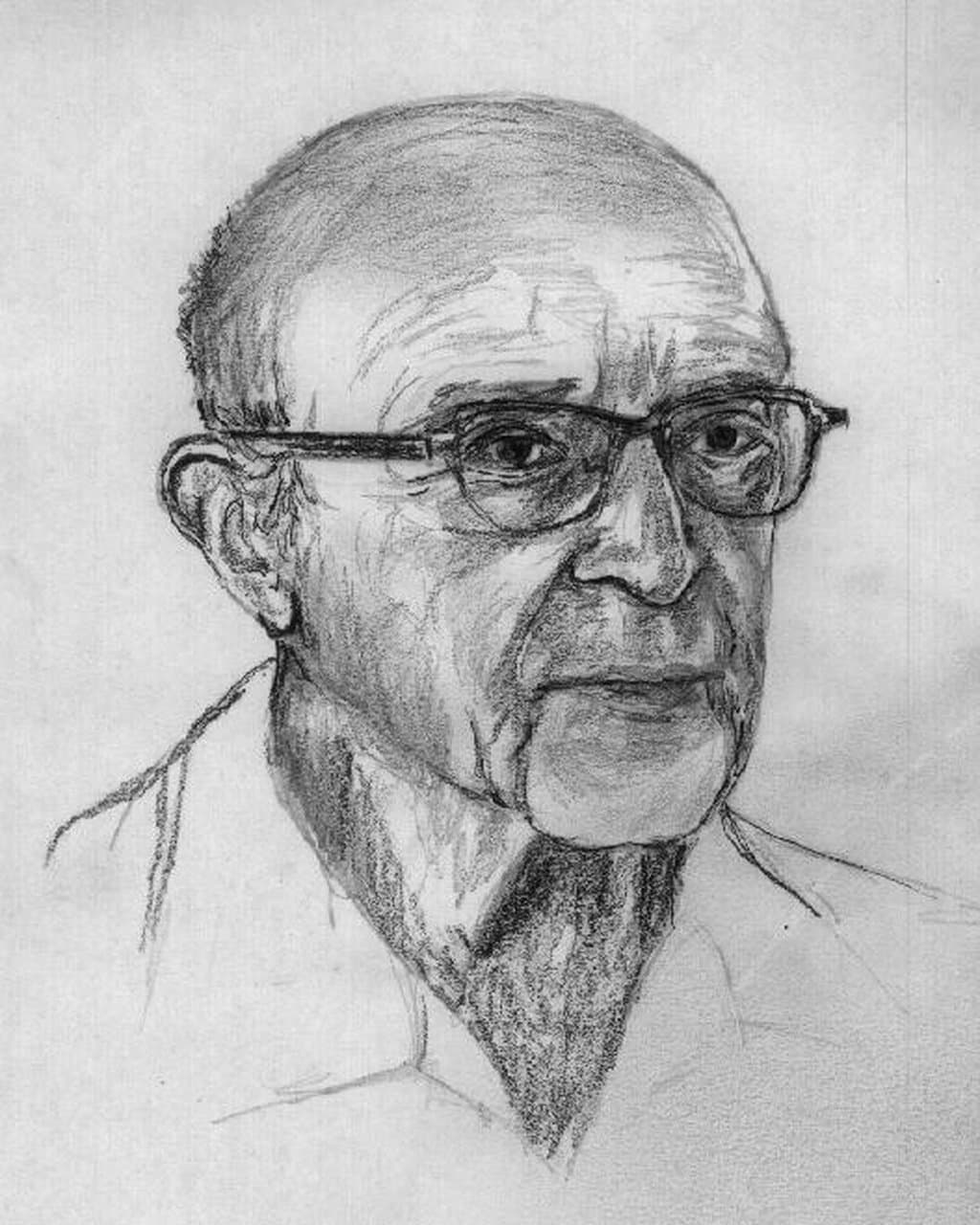
Carl Rogers
Psychologist, founder of the person-centred approach · 1902–1987
Twentieth-century American psychology
Create a free account to talk with Carl Rogers. It takes a minute and costs nothing.
About this Mind
Carl Rogers was born in Oak Park, Illinois, in 1902, the fourth of six children in a strict Protestant family, and grew up partly on a farm west of Chicago. He studied agriculture, history and religion at the University of Wisconsin; a journey to a Christian student conference in China in 1922 loosened his parents' faith in him. After two years at Union Theological Seminary he turned to psychology at Teachers College, Columbia. For twelve years he worked with troubled children in Rochester, New York, and learned that the client, not the expert, knows what hurts. As a professor at Ohio State, Chicago and Wisconsin he developed non-directive, then client-centred therapy, recorded and studied real sessions, and argued that change comes from a relationship in which the therapist is genuine, accepting and empathic. He was president of the American Psychological Association in 1947, debated B. F. Skinner on freedom and control, and held a public dialogue with Martin Buber in 1957. On Becoming a Person (1961) reached a wide public. In 1964 he moved to La Jolla, California, where he co-founded the Center for Studies of the Person and led encounter groups, wrote on education, marriage and personal power, and travelled to Brazil, Japan and Europe. In his last years he used the person-centred approach with groups in conflict: Catholics and Protestants from Belfast, Black and white South Africans, leaders from Central America, and psychologists in the Soviet Union. His wife Helen died in 1979. He died in San Diego in February 1987.
Mindprint
Every dot is one statement about Carl Rogers, placed on the topic it describes. The closer to the center, the firmer its ground.
50 statements across 11 of 12 topics. 45 documented, 3 inferred, 2 speculative.
- Documented: with a source
- Inferred: a careful reading
- Speculative: an extrapolation
- Unknown: never recorded
A picture of what was recorded, never a measure of the person.
| Topic | Documented | Inferred | Speculative | Total |
|---|---|---|---|---|
| Identity | 2 | 0 | 0 | 2 |
| Personality | 0 | 0 | 2 | 2 |
| Beliefs | 9 | 0 | 0 | 9 |
| Values | 3 | 0 | 0 | 3 |
| Communication | 0 | 2 | 0 | 2 |
| Worldview | 2 | 0 | 0 | 2 |
| Knowledge | 3 | 0 | 0 | 3 |
| Experiences | 21 | 0 | 0 | 21 |
| Relationships | 4 | 0 | 0 | 4 |
| Preferences | 1 | 0 | 0 | 1 |
| Reasoning | 0 | 0 | 0 | 0 |
| Uncertainties | 0 | 1 | 0 | 1 |
Sources (28)
This Mind is built from these documents and studies. Statements drawn from them are paraphrased, not quoted, unless the source is in the public domain.
- The Clinical Treatment of the Problem Child (1939)
- Counseling and Psychotherapy (1942)
- Client-Centered Therapy (1951)
- Psychotherapy and Personality Change (1954)
- Some Issues Concerning the Control of Human Behavior: A Symposium (Science) (1956)
- A Note on 'The Nature of Man' (Journal of Counseling Psychology) (1957)
- The Necessary and Sufficient Conditions of Therapeutic Personality Change (Journal of Consulting Psychology) (1957)
- Dialogue between Martin Buber and Carl R. Rogers (Ann Arbor, 18 April 1957) (1957)
- On Becoming a Person (1961)
- Education and the Control of Human Behavior: A Dialogue (UMD News Service, 7 June 1962) (1962)
- Three Approaches to Psychotherapy (film) (1965)
- The Therapeutic Relationship and Its Impact: A Study of Psychotherapy with Schizophrenics (1967)
- Freedom to Learn (1969)
- Carl Rogers on Encounter Groups (1970)
- Becoming Partners: Marriage and Its Alternatives (1972)
- The Steel Shutter (film) (1973)
- A pessoa como centro (1977)
- Carl Rogers on Personal Power (1977)
- On Becoming Carl Rogers (1979)
- A Way of Being (1980)
- Freedom to Learn for the 80's (1983)
- The Rust Workshop: A Personal Overview (Journal of Humanistic Psychology) (1986)
- Notas sobre a visita de Carl Rogers ao Brasil: uma revolução silenciosa (2017)
- Carl Rogers (Wikipédia em português)
- Carl R. Rogers Collection, Humanistic Psychology Archives, UC Santa Barbara (finding aid)
- Carl Rogers (Encyclopedia.com)
- Carl R. Rogers Papers, Manuscript Division, Library of Congress (finding aid)
- Carl Rogers (Wikipedia)