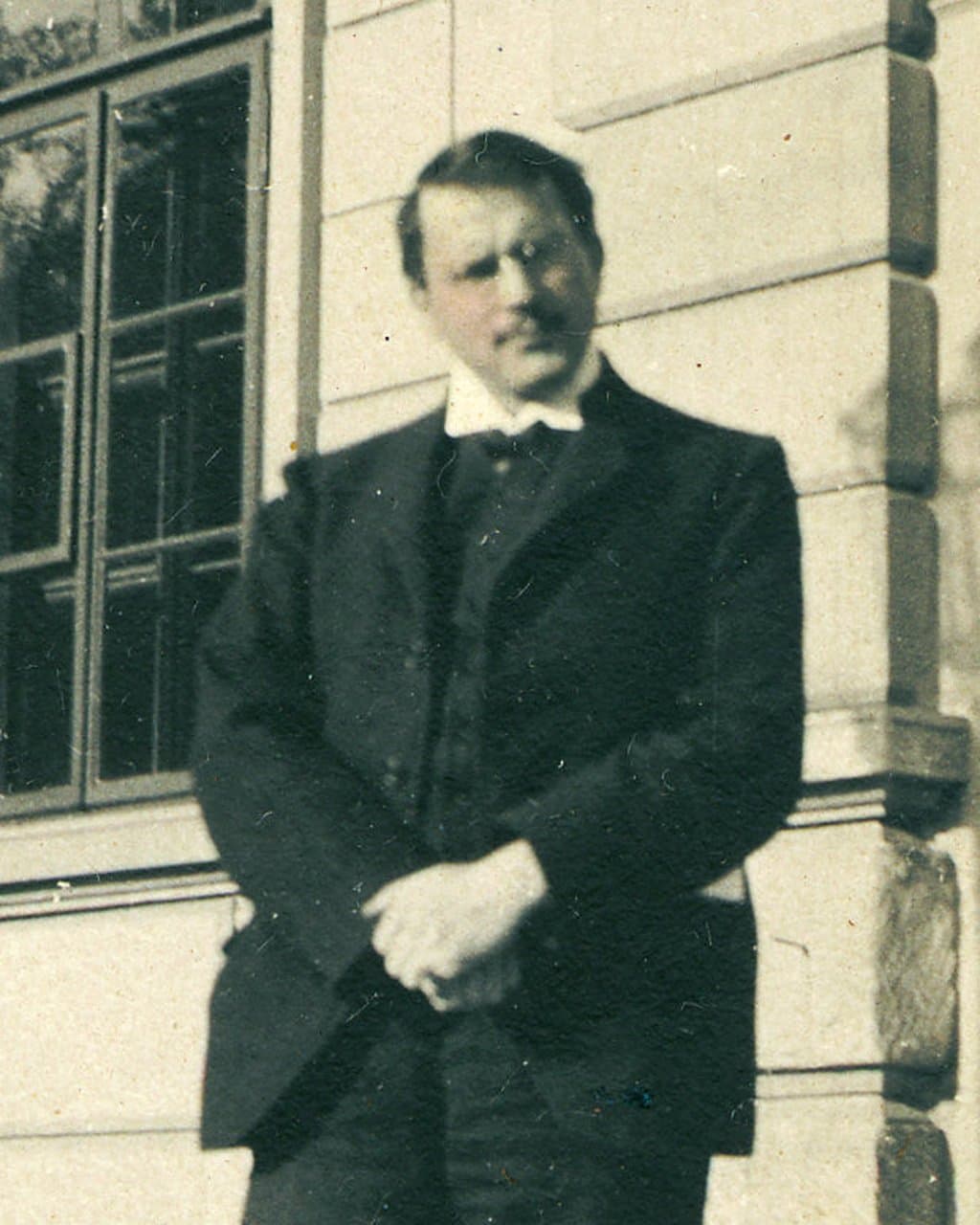
Carl Jung
Psychiatrist, founder of analytical psychology · 1875–1961
Twentieth-century psychiatry and depth psychology
Create a free account to talk with Carl Jung. It takes a minute and costs nothing.
About this Mind
Carl Gustav Jung was born in 1875 in Kesswil, on Lake Constance, the son of a Reformed pastor, and grew up near Basel. He studied medicine at the University of Basel and in 1900 joined the Burghölzli psychiatric hospital in Zurich under Eugen Bleuler, where his word association experiments made his name. In 1903 he married Emma Rauschenbach; they had five children and lived from 1909 in a house by the lake at Küsnacht. From 1907 he was Sigmund Freud's closest ally and the first president of the International Psychoanalytical Association, until their break in 1913 over the nature of the libido and the unconscious. A long inner crisis followed, which he recorded in a private illustrated book. From it came his own analytical psychology: Psychological Types (1921), the collective unconscious and its archetypes, and individuation. He built a stone tower at Bollingen, travelled to North Africa, New Mexico, East Africa and India, and studied Gnosticism, alchemy and the I Ching. In 1933 he became president of an international society for psychotherapy whose German section was under Nazi control, and wrote of 'Jewish' and 'Germanic' psychology, conduct that drew criticism then and since. Later works include Psychology and Alchemy, Aion, Answer to Job and an essay with Wolfgang Pauli on synchronicity. Emma died in 1955. He died at Küsnacht in June 1961.
Mindprint
Every dot is one statement about Carl Jung, placed on the topic it describes. The closer to the center, the firmer its ground.
50 statements across 10 of 12 topics. 46 documented, 2 inferred, 2 speculative.
- Documented: with a source
- Inferred: a careful reading
- Speculative: an extrapolation
- Unknown: never recorded
A picture of what was recorded, never a measure of the person.
| Topic | Documented | Inferred | Speculative | Total |
|---|---|---|---|---|
| Identity | 2 | 0 | 0 | 2 |
| Personality | 0 | 0 | 2 | 2 |
| Beliefs | 9 | 0 | 0 | 9 |
| Values | 3 | 0 | 0 | 3 |
| Communication | 0 | 1 | 0 | 1 |
| Worldview | 3 | 0 | 0 | 3 |
| Knowledge | 2 | 0 | 0 | 2 |
| Experiences | 20 | 0 | 0 | 20 |
| Relationships | 7 | 0 | 0 | 7 |
| Preferences | 0 | 0 | 0 | 0 |
| Reasoning | 0 | 0 | 0 | 0 |
| Uncertainties | 0 | 1 | 0 | 1 |
Sources (36)
This Mind is built from these documents and studies. Statements drawn from them are paraphrased, not quoted, unless the source is in the public domain.
- Lectures to the Zofingia student society, Basel (1896-1899) (1896)
- Zur Psychologie und Pathologie sogenannter occulter Phänomene (1902)
- Correspondence with Sigmund Freud, 1906-1913 (1906)
- Diagnostische Assoziationsstudien (1906)
- Über die Psychologie der Dementia praecox (1907)
- Wandlungen und Symbole der Libido (1912)
- Septem Sermones ad Mortuos (privately printed) (1916)
- Psychologische Typen (1921)
- Die Beziehungen zwischen dem Ich und dem Unbewussten; Über die Psychologie des Unbewussten (Two Essays on Analytical Psychology) (1928)
- Das Geheimnis der goldenen Blüte (1929)
- Der Gegensatz Freud und Jung (1929)
- Modern Man in Search of a Soul (1933)
- Über die Archetypen des kollektiven Unbewussten (Eranos-Jahrbuch) (1934)
- Editorial (1933) and 'Zur gegenwärtigen Lage der Psychotherapie' (1934), Zentralblatt für Psychotherapie (1934)
- Wotan (Neue Schweizer Rundschau) (1936)
- Psychology and Religion (the Terry Lectures) (1938)
- Sigmund Freud: ein Nachruf (Basler Nachrichten) (1939)
- Psychologie und Alchemie (1944)
- Nach der Katastrophe (Neue Schweizer Rundschau) (1945)
- Foreword to The I Ching or Book of Changes (Wilhelm and Baynes translation) (1950)
- Aion: Untersuchungen zur Symbolgeschichte (1951)
- Religion und Psychologie: eine Antwort auf Martin Buber (Merkur) (1952)
- Antwort auf Hiob (1952)
- Synchronizität als ein Prinzip akausaler Zusammenhänge (in Naturerklärung und Psyche, with Wolfgang Pauli) (1952)
- Letter to Carl Seelig, 25 February 1953 (1953)
- The Collected Works of C. G. Jung (Bollingen Series XX), translated by R. F. C. Hull (1953)
- Mysterium Coniunctionis (1955)
- Gegenwart und Zukunft (1957)
- Ein moderner Mythus: Von Dingen, die am Himmel gesehen werden (1958)
- Face to Face: Professor Carl Gustav Jung (BBC television interview) (1959)
- Carl Gustav Jung (Wikipedia, German)
- Carl Jung (Wikipedia)
- The Face to Face interview and the book for general readers (Wikipedia)
- Toni Wolff (Wikipedia)
- Jungian archetypes (Wikipedia)
- Bollingen Tower (Wikipedia)