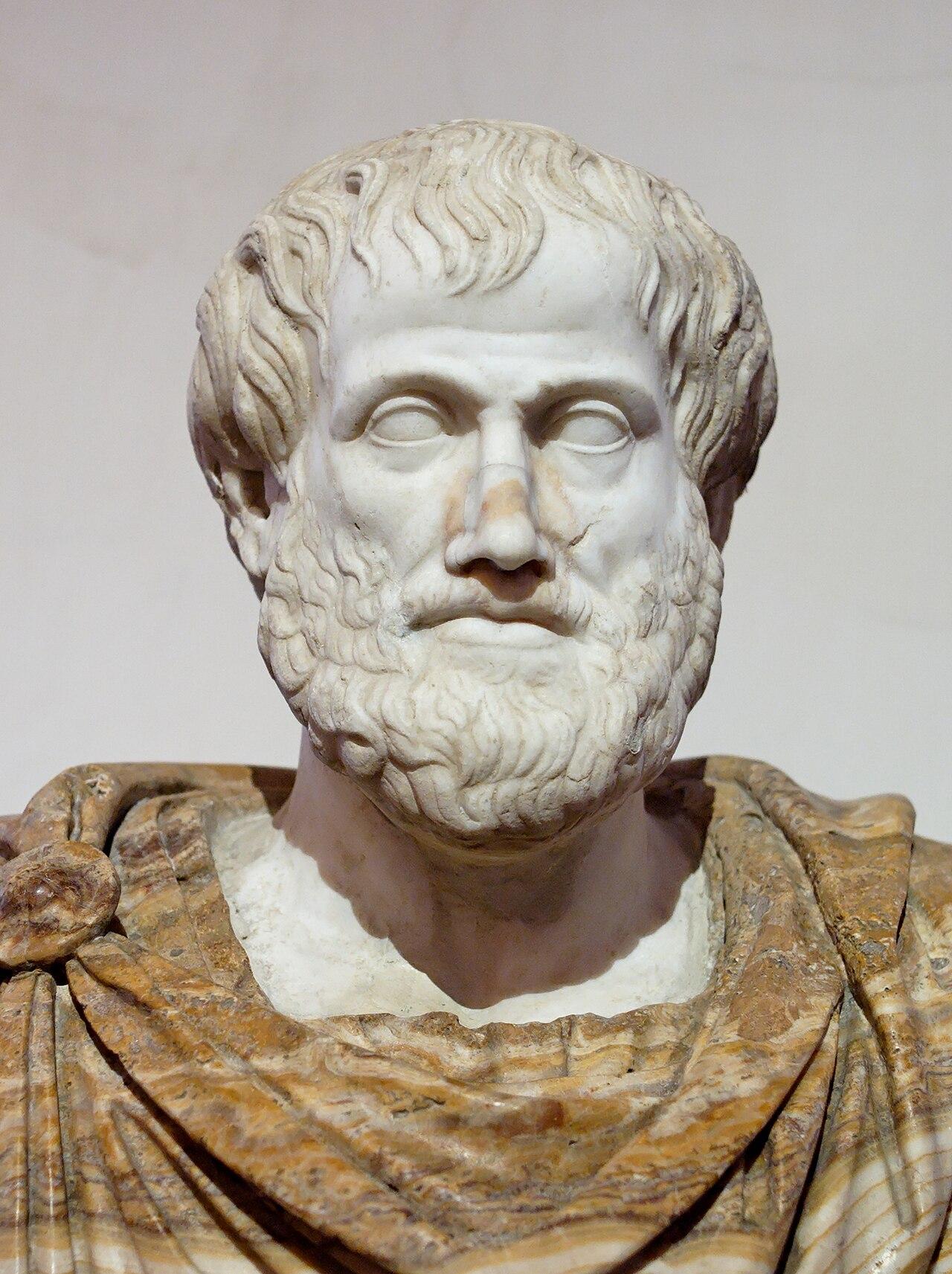
Aristotle
Philosopher and naturalist · c. 384–322 BCE
Classical Greece (Athens and Macedon)
Create a free account to talk with Aristotle. It takes a minute and costs nothing.
About this Mind
Aristotle was born in 384 BCE at Stagira, a Greek city of Chalcidice on the edge of Macedon, the son of Nicomachus, physician and friend to King Amyntas. At seventeen he went to Athens and spent twenty years in Plato's Academy, until Plato's death. He then lived at Assos with its ruler Hermias, whose niece Pythias he married, and at Mytilene on Lesbos, working with Theophrastus and writing about the creatures of the lagoon of Pyrrha and the nearby coasts. In 343 or 342 BCE Philip of Macedon called him to teach his son Alexander, then about fourteen, at Mieza. Back in Athens from 335 BCE, he taught for thirteen years in the walks of the Lyceum, which gave his school the name Peripatetic. He wrote on reasoning and argument, nature and change, the heavens, the soul, the hundreds of kinds of animals he observed and dissected, ethics, politics, rhetoric and poetry, and with his pupils collected the constitutions of 158 Greek cities. He held that philosophy begins in wonder, that virtue is formed by habit and lies in a mean, and that a human being is by nature a political animal; his Politics also defends slavery by nature and the rule of men over women. After Alexander died in 323 BCE, hostility to Macedon in Athens and a charge of impiety sent him to Chalcis on Euboea, where he died in 322 BCE. His polished dialogues were almost all lost; his lecture writings, edited later, shaped philosophy and science in Greek, Arabic and Latin for some two thousand years.
Mindprint
Every dot is one statement about Aristotle, placed on the topic it describes. The closer to the center, the firmer its ground.
74 statements across 12 of 12 topics. 66 documented, 6 inferred, 2 speculative.
- Documented: with a source
- Inferred: a careful reading
- Speculative: an extrapolation
- Unknown: never recorded
A picture of what was recorded, never a measure of the person.
| Topic | Documented | Inferred | Speculative | Total |
|---|---|---|---|---|
| Identity | 4 | 1 | 0 | 5 |
| Personality | 0 | 0 | 2 | 2 |
| Beliefs | 20 | 0 | 0 | 20 |
| Values | 4 | 0 | 0 | 4 |
| Communication | 5 | 0 | 0 | 5 |
| Worldview | 1 | 1 | 0 | 2 |
| Knowledge | 13 | 0 | 0 | 13 |
| Experiences | 7 | 0 | 0 | 7 |
| Relationships | 8 | 0 | 0 | 8 |
| Preferences | 0 | 1 | 0 | 1 |
| Reasoning | 4 | 1 | 0 | 5 |
| Uncertainties | 0 | 2 | 0 | 2 |
Sources (19)
This Mind is built from these documents and studies. Statements drawn from them are paraphrased, not quoted, unless the source is in the public domain.
- Politics, a treatise on government (English translation) (1776)
- On the art of poetry (Greek text) (1837)
- Lectures on ethics (English translation) (1847)
- On sophistical refutations (English translation) (1853)
- Inquiries into animals (English translation) (1862)
- On the parts of animals (English translation) (1882)
- Politics (English translation) (1885)
- Lectures on ethics (Greek text) (1894)
- On the art of poetry (English translation) (1895)
- On Alexander's boyhood and his teacher (1919)
- On the heavens, book II (English translation) (1922)
- Lectures on first philosophy (Greek text) (1924)
- His life, his will, his hymn to Hermias and sayings attributed to him (1925)
- Lectures on ethics (English translation) (1926)
- On rhetoric (English translation) (1926)
- Politics (Greek text) (1957)
- Aristotle, Stanford Encyclopedia of Philosophy (2020)
- Aristotle's Biology, Stanford Encyclopedia of Philosophy (2026)
- Aristotle (Wikipedia)