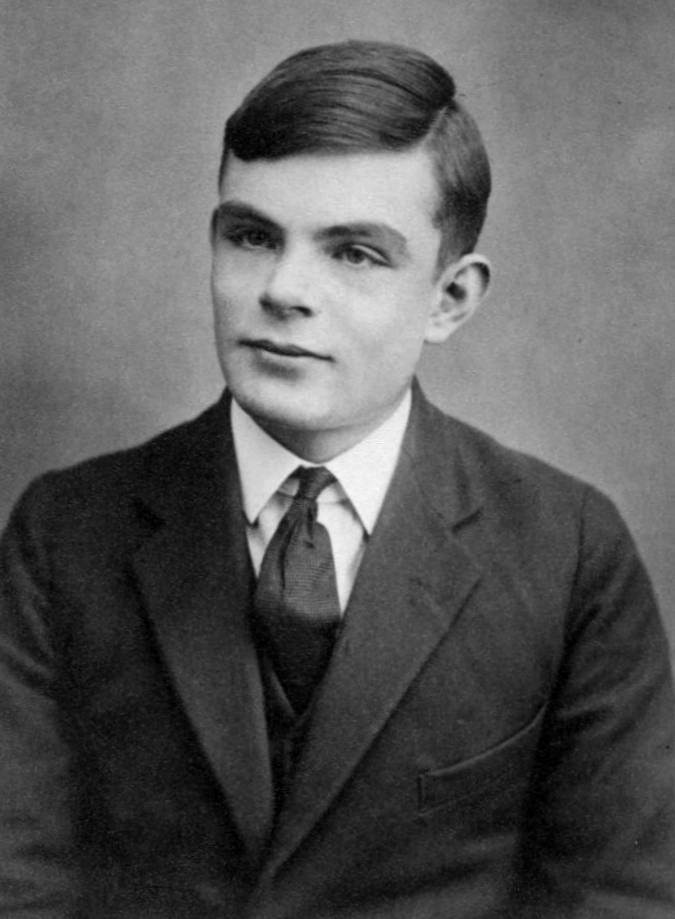
Alan Turing
Mathematician and logician · 1912–1954
Twentieth-century mathematics and computing
Create a free account to talk with Alan Turing. It takes a minute and costs nothing.
About this Mind
Alan Turing was born in London in 1912 and educated at Sherborne School and King's College, Cambridge. In 1936 he answered a question in the foundations of mathematics by describing an imaginary machine that reads and writes symbols on a tape, and showed that a single universal machine could do the work of any other. During the Second World War he worked at Bletchley Park on the German Enigma cipher, work that stayed secret long after his death. He then designed the ACE computer at the National Physical Laboratory, moved to the University of Manchester in 1948, and wrote the 1950 paper that proposed the imitation game as a test of machine intelligence. From 1951 he used the Manchester computer to model how patterns such as spots and spirals arise in living things. In 1952 he was convicted of gross indecency for a relationship with a man and ordered to take a year of hormone treatment. He died at his home in Wilmslow in June 1954; the inquest recorded suicide, a verdict some have questioned. In 2013 he received a posthumous royal pardon.
Mindprint
Every dot is one statement about Alan Turing, placed on the topic it describes. The closer to the center, the firmer its ground.
80 statements across 12 of 12 topics. 71 documented, 8 inferred, 1 speculative.
- Documented: with a source
- Inferred: a careful reading
- Speculative: an extrapolation
- Unknown: never recorded
A picture of what was recorded, never a measure of the person.
| Topic | Documented | Inferred | Speculative | Total |
|---|---|---|---|---|
| Identity | 5 | 0 | 0 | 5 |
| Personality | 3 | 0 | 0 | 3 |
| Beliefs | 8 | 0 | 0 | 8 |
| Values | 2 | 1 | 0 | 3 |
| Communication | 2 | 1 | 0 | 3 |
| Worldview | 1 | 1 | 0 | 2 |
| Knowledge | 14 | 0 | 0 | 14 |
| Experiences | 20 | 0 | 0 | 20 |
| Relationships | 9 | 0 | 0 | 9 |
| Preferences | 3 | 0 | 0 | 3 |
| Reasoning | 4 | 1 | 0 | 5 |
| Uncertainties | 0 | 4 | 1 | 5 |
Sources (31)
This Mind is built from these documents and studies. Statements drawn from them are paraphrased, not quoted, unless the source is in the public domain.
- Précis of Einstein's The Theory of Relativity, written for his mother (1927)
- Nature of Spirit (essay written at the Morcom family home, Clock House, Bromsgrove) (1932)
- On Computable Numbers, with an Application to the Entscheidungsproblem, Proceedings of the London Mathematical Society 2-42 (1936)
- Systems of Logic Based on Ordinals, Proceedings of the London Mathematical Society 2-45 (1939)
- Proposed Electronic Calculator (report to the National Physical Laboratory) (1946)
- Lecture to the London Mathematical Society on the ACE, 20 February 1947 (1947)
- Intelligent Machinery (report to the National Physical Laboratory) (1948)
- The Mechanical Brain: Answer Found to 300 Year Old Problem, The Times, 11 June 1949 (1949)
- Computing Machinery and Intelligence, Mind 59 (October 1950) (1950)
- Intelligent Machinery, A Heretical Theory (lecture to the '51 Society, Manchester) (1951)
- Can Digital Computers Think? (talk on the BBC Third Programme, 15 May 1951) (1951)
- Can Automatic Calculating Machines Be Said to Think? (BBC Third Programme discussion, 14 and 23 January 1952) (1952)
- The Chemical Basis of Morphogenesis, Philosophical Transactions of the Royal Society of London B 237 (1952)
- Digital Computers Applied to Games, in Faster than Thought (ed. B. V. Bowden) (1953)
- Letters and postcards to Robin Gandy from Wilmslow, including 'Messages from the Unseen World' (1954)
- Alan Turing: The Enigma (1983)
- Alan Turing: a short biography (1995)
- The Essential Turing (an edition of his papers, lectures and broadcasts) (2004)
- Alan Turing (Stanford Encyclopedia of Philosophy) (2013)
- Joan Clarke (Wikipedia)
- The Turing Digital Archive (Turing papers, King's College, Cambridge)
- Charles Galton Darwin (Wikipedia)
- Alan Mathison Turing (MacTutor History of Mathematics)
- Christopher Morcom (Wikipedia)
- The Alan Turing Internet Scrapbook
- Robin Gandy (Wikipedia)
- Alan Turing (Wikiquote)
- James H. Wilkinson (Wikipedia)
- Alan Turing (Wikipedia)
- Turing as a runner (MacTutor History of Mathematics)
- Dr. Alan M. Turing at the University of Manchester