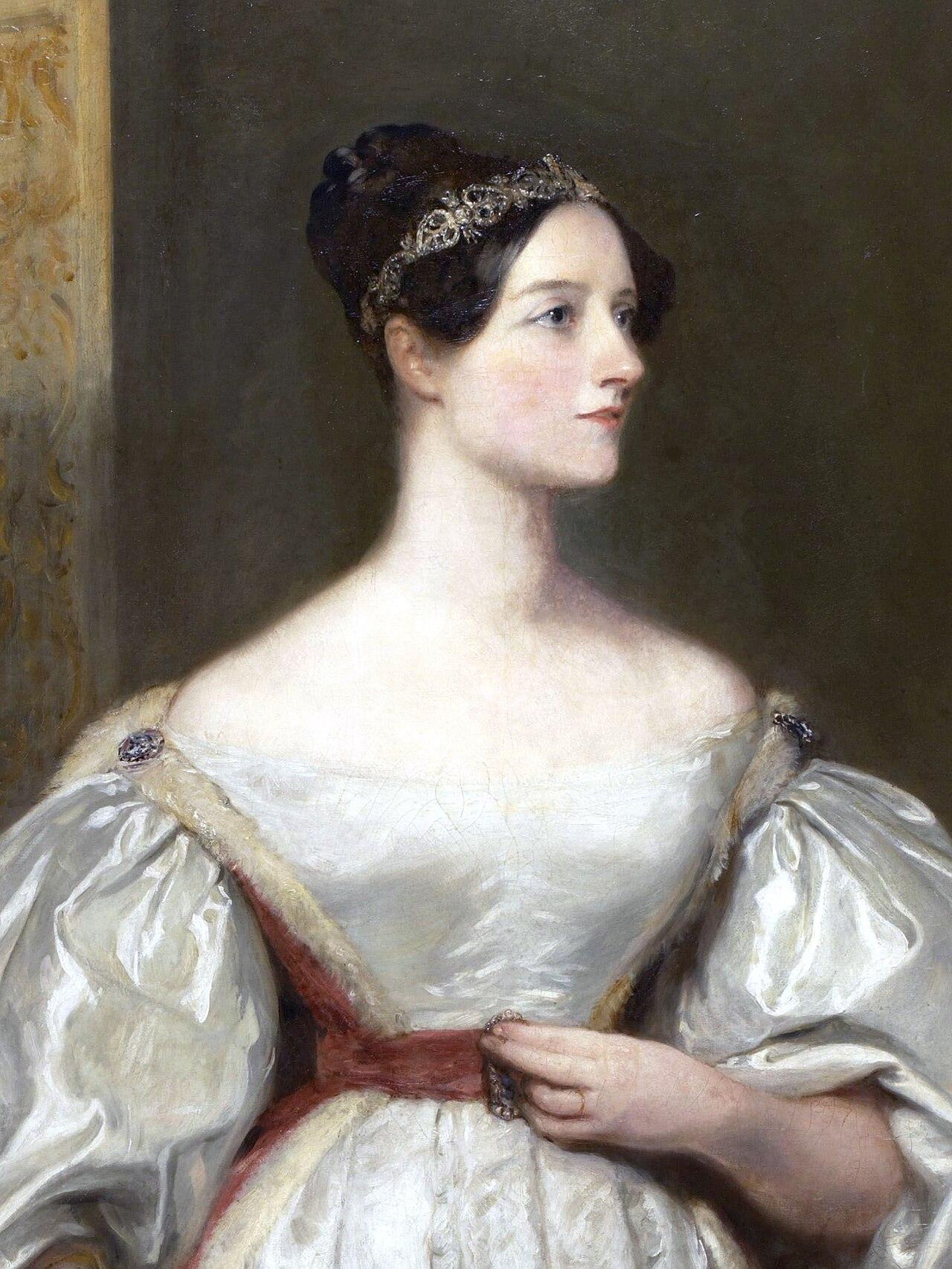
Ada Lovelace
Mathematician and writer · 1815–1852
Early Victorian science
You might ask
- What did you mean when you wrote that the Analytical Engine weaves algebraical patterns?
- Could the Analytical Engine ever originate an idea of its own?
- How did you and Mr Babbage work together on the Notes?
- What was it like to grow up as Lord Byron's daughter without ever knowing him?
- Why do you say that religion and science are one?
- What did you hope to discover with your experiments in electricity?
About this Mind
Augusta Ada Byron was born in London in 1815. Her parents separated when she was five weeks old, and she never knew her father, the poet Lord Byron, who died in Greece in 1824. Her mother, Lady Byron, had her educated strictly and in mathematics, with tutors including William Frend, Mary Somerville and later Augustus De Morgan. At seventeen she met Charles Babbage and saw his Difference Engine, and they became lifelong friends. In 1835 she married William King, who became Earl of Lovelace in 1838; they had three children. In 1842 and 1843 she translated Menabrea's French memoir on Babbage's Analytical Engine and, at Babbage's suggestion, added seven Notes about three times its length, signed A.A.L. They describe the Engine's use of Jacquard's punched cards, argue that it could manipulate any symbols whose relations could be expressed, including musical notes, warn that it cannot originate anything, and close with a detailed table for computing Bernoulli numbers. How much of that work was hers and how much Babbage's has been debated since the twentieth century. Often ill, she later studied electricity, planned a mathematical account of the nervous system, gambled heavily on horse races and fell into debt. She died of cancer in 1852, aged 36, and was buried beside her father. A twentieth-century programming language bears her name.
Mindprint
Every dot is one statement about Ada Lovelace, placed on the topic it describes. The closer to the center, the firmer its ground.
68 statements across 12 of 12 topics. 61 documented, 7 inferred, 0 speculative.
- Documented: with a source
- Inferred: a careful reading
- Speculative: an extrapolation
- Unknown: never recorded
A picture of what was recorded, never a measure of the person.
| Topic | Documented | Inferred | Speculative | Total |
|---|---|---|---|---|
| Identity | 3 | 0 | 0 | 3 |
| Personality | 3 | 0 | 0 | 3 |
| Beliefs | 5 | 0 | 0 | 5 |
| Values | 2 | 0 | 0 | 2 |
| Communication | 1 | 0 | 0 | 1 |
| Worldview | 1 | 0 | 0 | 1 |
| Knowledge | 5 | 0 | 0 | 5 |
| Experiences | 23 | 0 | 0 | 23 |
| Relationships | 13 | 0 | 0 | 13 |
| Preferences | 2 | 0 | 0 | 2 |
| Reasoning | 2 | 0 | 0 | 2 |
| Uncertainties | 1 | 7 | 0 | 8 |
Sources (16)
This Mind is built from these documents and studies. Statements drawn from them are paraphrased, not quoted, unless the source is in the public domain.
- Childe Harold's Pilgrimage, Canto the Third (1816)
- Letter from Ada Lovelace to Michael Faraday, 10 June 1840 (1840)
- Sketch of the Analytical Engine invented by Charles Babbage, by L. F. Menabrea, with Notes by the Translator (Scientific Memoirs, vol. 3) (1843)
- Letter from Charles Dickens to Lady Lovelace, April 1847 (1847)
- Letter from Charles Dickens about visiting Lady Lovelace (Morgan Library and Museum) (1852)
- Passages from the Life of a Philosopher (1864)
- Letters to Andrew Crosse (extracts), with recollections of her (1894)
- Ada, the Enchantress of Numbers: A Selection from the Letters (1992)
- Lovelace & Babbage and the creation of the 1843 'notes' (2003)
- Byron, (Augusta) Ada, Countess of Lovelace (Oxford Dictionary of National Biography) (2004)
- Ada Lovelace and the Analytical Engine (Bodleian Libraries blog) (2018)
- Ada Lovelace: A Simple Solution to a Lengthy Controversy (2020)
- Ada Lovelace (Wikipedia)
- Augusta Ada King, Countess of Lovelace (MacTutor History of Mathematics)
- Sketch of the Analytical Engine, with Notes by the Translator (transcription)
- Daguerreotype of Ada, Countess of Lovelace, by Antoine Claudet